
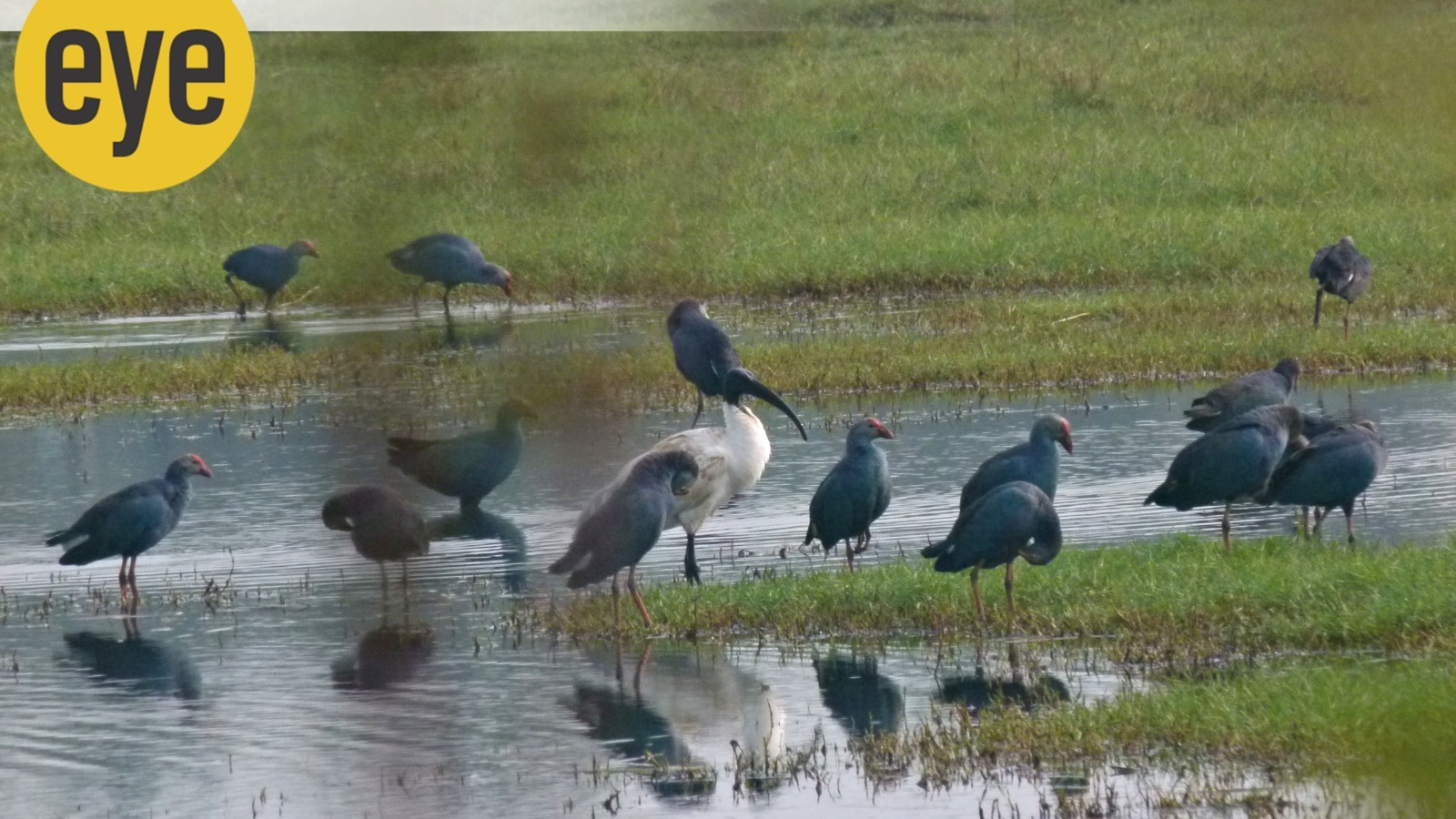
If you look far enough, you can't miss the purple swamphens, the sandpipers and the spoonbills near Goa's almost-forgotten waterbody.
This was another lake in Goa that I wanted to explore; about an hour’s drive away and, apparently, a popular picnic spot, with pedal boats and bungee jumping.
Not many waterbirds the website warned but the surrounding forests had owls and crested serpent eagles.
There was also a Goa Tourist Development Corporation ‘Residency’ at the lake with a restaurant attached.
After a tangled drive through villages and countryside we reached Mayem Lake, to find a school bus decanting a batch of Class V (I would think) children, out on a nature trip with their teachers.
Walking down to the lake I realised what the website had mentioned was true.
Apart from a lone, forlorn little black cormorant at one end there was not a bird to be seen.
The lake was large and calm, presided over by the hideous bungee jumping platform at the far end, and swan-shaped pedal boats moored nearby.
This was hopeless; those poor kids!
We asked the security guard if there was any birding area nearby and he nodded excitedly and proceeded to tumble out with a spaghetti of directions, ‘turn left, turn right, come to Y junction…,’ assuring us of many migratory birds at the location he was mentioning.
I couldn’t make head or tail of anything he said, but our resourceful driver got the gist so off we went.
After another half-an-hour’s up and down drive, this through forested country and areca palm (supermodel slim and tall) and coconut plantations we emerged on an open road, with water-bodies glistening on either side.
And then the contented murmur of waterbirds.
In the large waterbody on the northern side, a gathering of at least 500 purple swamphens , went about the task of finding breakfast.
They seemed amicable enough though occasionally a difference of opinion (‘you’re in my area, butt out) broke out.
I had never seen so many swamphens in one location before.
And scanning across the lake revealed they were not the only ones here.
Shining coppery-gold in the early light were about a dozen Brahminy duck, plump as cushions, doing their morning ablutions.
A little later, they were joined by a flock of spot-billed ducks , all salt and pepper.
They are Indian residents, and now settled smugly on the water and wagged their tails approvingly.
Tall and severe and blazing white, large egrets stood ramrod still, while purple herons, always lovely in resin and mauve, unfurled their great wings and flew low over the water with all the dignity of a head of state.
A single black-winged stilt (notorious for liking polluted water) stood knee deep in the midst of the swamphens, unmolested, and far in the distance were two more herons – perhaps our common pond heron, though these seemed to crouch lower and had gingery streaks across their flanks and hunched postures (as if from scoliosis) suggesting bitterns, though this was not exactly the kind of surroundings they prefer.
They like laying low amidst tall reeds.
There is a sudden commotion as all the plump swamphens put their heads down and flee clumsily from one side of the waterbody to the other.
Instinctively you look up for a raptor – and there it is, an osprey winging swiftly over, its head down as it surveyed the water below.
Just beyond your line of sight, obstructed by a tree, it dives and then rises again, a fish clutched in its claws – it took less than five minutes to get its breakfast and wings swiftly away to the west, a feat any fisherman would envy.
Then at the very far end, you spot a flickering of white and pepper-brown as a flock of sandpipers, over a hundred strong, jink and fly, banking one way and then another as they race over the water excitedly.
When they settle in the shallows they seemingly vanish.
Here, too, there is a solitary little black cormorant doing sentry duty from its post on a tree at the edge of the lake.
Just below it, there’s a bee-eater launching sallies and when and it lands back, flaring it tail, a lovely flame-blue – you have it: blue-tailed bee-eater!
A little later its position has been usurped by a long-tailed (earlier rufous-backed) shrike, ever dangerous with its executioner’s mask and hook-tipped bill.
Latecomers are now arriving for breakfast: A party of glossy ibis, iridescently black and deep chestnut land and get busy, soon joined by a black-headed white ibis.
Suddenly there are a foursome of spoonbills amongst them, manfully ‘minesweeping’ with their ladle-like bills.
A young motorcyclist stops and looks at them excitedly saying that this is the first time he has seen spoonbills here.
There is an immense sense of serenity that envelopes you as you watch these birds, none of them rarified gentry, but that doesn’t seem to matter.
As you prepare to leave, a pair of swamphens face off with bowed heads, which is apparently what they do while courting.
They only breed just before the monsoons, so it seems early for that – maybe they were just adolescents flirting with each other.
As you drive off, the wholly baseless accusations of a red-wattled lapwing ‘did-ye-do-it?
Did-ye-do-it?’ rings in your ears.
The drive back is via a different more picturesque and forested route, with waterbodies glinting alongside the road.
The tall upright figure of a white-necked stork, pops up from one, and then you’ve driven past it… Later, in the newspaper you read that leopards haunt the villages in this area (Aldona for example) in the evenings, picking up pet dogs.
Related Stories


Source: This article was originally published by The Indian Express
Read Full Original Article →
Comments (0)
No comments yet. Be the first to comment!
Leave a Comment