
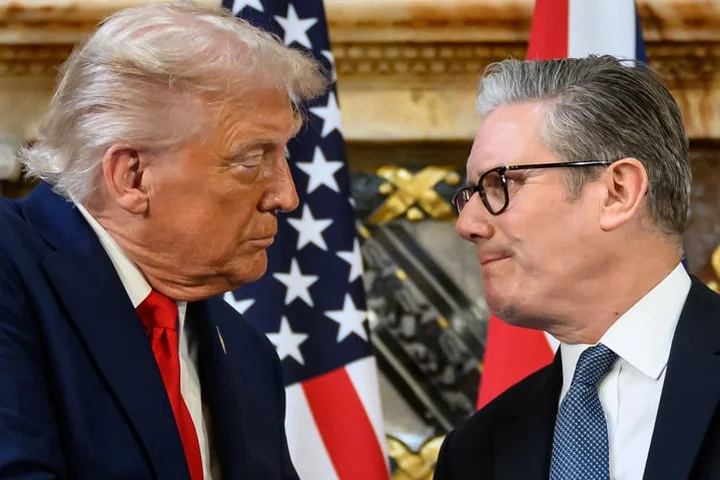
Senior ministers have hit out at Donald Trump over his Iran war as millions of people in Britain face rising bills due to its economic fallout.
In what appeared to be a toughening of language against the US president, Chancellor Rachel Reeves branded the conflict a “folly” .
She accused the president of having had no exit strategy and going into the war “without a clear idea of what they were trying to achieve”.
Her Treasury deputy, James Murray, doubled down on the criticism.
“What makes us most frustrated and angry is the impact that it is having on people here in Britain,” the Chief Secretary to the Treasury, and MP for Ealing North, told Sky News.
He stressed that earlier forecasts had predicted that inflation, mortgage rates, interest rates and borrowing were due to fall.
But a report by the International Monetary Fund showed the Government’s economic plans have been rocked by the Iran war , which has sparked the biggest-ever oil supply shock after Iran effectively closed the Strait of Hormuz .
“Even though it’s not our war it’s going to have an impact on our economy,” Mr Murray stressed, with petrol and diesel prices rising sharply and ahead of May local elections in England when Labour is facing a hammering including in London .
Mortgage rates have risen and energy bills could increase by hundreds of pounds in the autumn .
The IMF analysis showed the UK is the hardest hit of the G7 major economies, the US, UK, Germany, Japan, France, Italy and Canada.
The influential financial body said the spike in energy prices caused by the war will help push UK inflation towards 4 per cent, double the Bank of England’s inflation target, and contribute to higher costs for households.
It said UK gross domestic product (GDP) is set to grow by a miserly 0.8 per cent in 2026 and 1.3 per cent in 2027.
As recently as January, the IMF had predicted 1.3 per cent growth in this year and 1.5 per cent in 2027.
Middle East conflict sparked major supply shock, says Bank of England boss
'Iron Dome may be needed' to protect London from missile attacks
Chancellor to hold talks with US counterpart after strong criticism of Iran war
Discover a hidden island paradise in the Indian Ocean
Trump has repeatedly clashed with Sir Keir Starmer over the war after he refused to allow US planes to fly from UK bases for the initial and offensive airstrikes.
The Government has let America use RAF bases for “defensive” missions , such as striking Iranian missile sites, and for action to reopen the Strait of Hormuz, through which a fifth of the world’s oil and liquefied natural gas is transported.
In his latest criticism of Sir Keir, the US president told Sky News that Britain was making a “tragic mistake” on not opening up more North Sea oil drilling and on immigration.
Pressed on the Special Relationship, Trump added: “With who?” according to the report, and suggested that America could seek to change the trade deal with Britain.
Asked about the comments, Mr Murray said: “The Special Relationship between the UK and the US is deep, long-standing, it’s bigger than any single occupant of Downing Street or the White House.”
Earlier, Ms Reeves, speaking in Washington, had told The Mirror: "This is a war that we did not start.
It was a war that we did not want.
“I feel very frustrated and angry that the US went into this war without a clear exit plan, without a clear idea of what they were trying to achieve."
At a meeting of the IMF, she was due to meet her US counterpart Scott Bessent after he said “a small bit of economic pain” caused by the Iran war was worth it to prevent Tehran getting a nuclear weapon.
The United States said on Wednesday that its military had completely halted trade going in and out of Iran by sea, while Trump said talks with Tehran on ending the war could resume this week, sending oil prices down for a second day.
He suggested that the war is “close to over” and that it was “very possible" a deal with Iran would be reached by the time King Charles visits the US between April 27 and 30.
But his rhetoric has often not matched the reality on the ground.
About 5,000 people have died in the hostilities, including about 3,000 in Iran and 2,000 in Lebanon .
Trump said negotiations between US and Iranian officials could resume in Pakistan in the next two days and Vice President JD Vance, who led weekend talks that ended without a breakthrough, said he felt positive about where things stood.
"I think you’re going to be watching an amazing two days ahead," Trump told ABC News, adding he did not think it would be necessary to extend a two-week ceasefire that ends on April 21.
Officials from Pakistan, Iran and the Gulf also said negotiating teams from the US and Iran could return to Pakistan later this week, although one senior Iranian source said no date had been set.
Despite the optimistic note, more vessels were being turned back under the US blockade on Iranian ports.
Admiral Brad Cooper, the head of the US Central Command, said American forces had completely halted economic trade going in and out of Iran by sea, which he said fuels 90 per cent of Iran's economy.
"In less than 36 hours since the blockade was implemented, U.S.
forces have completely halted economic trade going into and out of Iran by sea," Cooper said in a post on X.
The signs of diplomatic engagement to end the conflict that began on February 28 helped calm oil markets, pressing benchmark prices below $100 (£74) for a second day on Wednesday.
Asian stocks rose while the safe-haven dollar stabilised after falling for a seventh straight session overnight.
Related Stories


Source: This article was originally published by Evening Standard
Read Full Original Article →
Comments (0)
No comments yet. Be the first to comment!
Leave a Comment