
We’ve tested many smart leak detectors over the past few years, and these are our favorites.
Insurers love them, so before you go shopping, it’s worth checking with yours to see what they offer or recommend, and whether installing a leak sensor can reduce your premiums.
Updated May 2026: I added a water leak detector from Shelly, reorganized our picks, added a note on the Ikea sensor, added information on where to put your detectors, and updated prices.
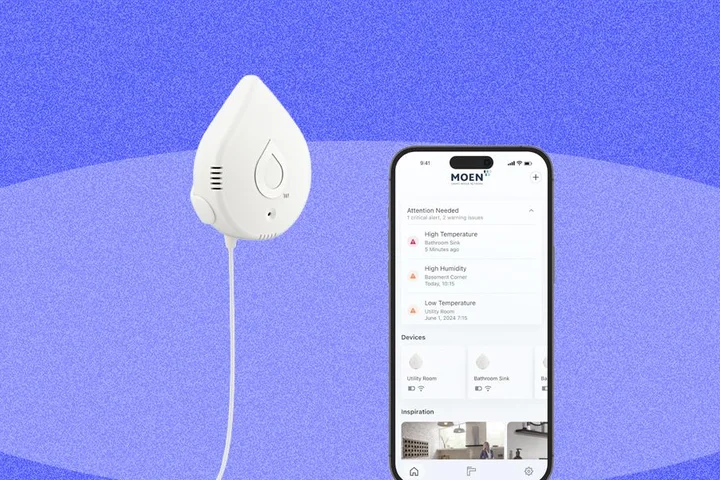
Shaped like a drop of water, this versatile standalone device alerts you within seconds of detecting a leak and offers compelling extras like temperature tracking at an affordable price.
It's a breeze to set up via the app ( Android , iOS ) and was swift and consistent in my testing, firing off a push notification, email, and text message every time it detected water.
(These can be configured to your preferences.) It also sounds a loud alarm and flashes a red LED.
The device has three metal feet to detect water, but you can also mount it on the wall and attach the included wired disc sensor instead.
Moen also offers a 6-foot leak-sensing cable ($35) that detects water along its entire length, and up to three of these can be chained together to cover a larger area.
Flo Smart Water Monitor and Shutoff
From the simple setup to the swift and reliable alerts, YoLink’s water leak sensors impressed.
YoLink offers three types of sensors: Sensor 1 detects water dripping onto or rising beneath it, Sensor 2 has a cord that detects water along its length, and Sensor 3 has water-sensing electrodes on the tip, making it suitable for monitoring the water level in a tank.
Each can be easily added to the app by scanning a QR code on the device and pressing a button.
All three come with two AAA batteries installed and detected water swiftly and reliably in my testing while sending notifications to my phone.
YoLink’s sensors use the long-range (up to a quarter of a mile) and low-power LoRa standard network, and don’t need a Wi-Fi signal as they link directly to a hub.
The hub connects to your router, ideally via the Ethernet cable provided, and must be plugged into an outlet.
The starter kit we are linking here includes the hub and four Water Leak Sensor 1 units.
The sensors detect water immediately—flashing red and sending alerts as notifications on your phone.
There's no sound from the Water Leak Sensor 1, though, or the standard hub.
The Water Leak Sensor 2 and 3 ($30 each) have an inbuilt sounder, and you can buy a SpeakerHub ($30) or a wireless Smart Siren ($29) that goes up to 110 decibels.
The straightforward app also allows you to set up customized alarm strategies and automation (YoLink offers a wide range of sensor types beyond water detection, and the ecosystem works with IFTTT and Alexa).
While it may take a few devices and some tinkering to configure the system to your linking, YoLink’s detectors are affordable, versatile, and reliable, and LoRa is ideal for larger properties with Wi-Fi issues.
Best Budget Water Leak Detector
Our budget pick comes from X-Sense, and includes three of the best smart water leak detectors I have tested plus a hub for a very reasonable price.
Plug the hub in and connect it to your Wi-Fi network ( 2.4-GHz band only ), place the detectors in leak-prone spots, and you're good to go.
The detectors are round and fairly large, but I love that they have a channel on top with two prongs that alert if there are any drips.
The four prongs on the underside are equally good at detecting pools of water (as little as 0.4 mm).
Water triggers the detector to emit a loud beeping, and the LED flashes red.
You can also choose from three alert sounds on the hub, which go up to an ear-splitting 100 decibels.
You can tweak the volume in the app and use the physical buttons on either to stop the alarm.
Alerts also came through reliably and swiftly on my phone as push notifications with an alarm sound.
These worked equally well whether my phone was connected to Wi-Fi or the cellular network.
Each sensor takes two AAA batteries, and I love that you can see the battery level in the app (it also sends warnings when power is low).
TP-Link Tapo T300 Water Leak Detector
First Alert L1 Wi-Fi Water Leak and Freeze Detector
Ikea Badring for $13 : Super affordable, with a simple design, this Zigbee detector alerted reliably during testing.
The Ikea Badring is a good choice if you already have an Ikea Dirigea hub ($109) to connect to for notifications on your phone.
But it works out quite pricey if you don't, and it's not compatible with other hubs, such as the Ikea Tradfri.
It does have an alert sound that goes as high as 90 decibels, but doesn’t carry far, and I wouldn’t rely on it alone.
You must supply your own AAA battery, and this leak detector is only IP44 rated, so there’s a risk of malfunction if it gets immersed.
This line is about to be discontinued, so you may prefer to opt for the new Matter-supporting Ikea Klippbok, which I plan to test next.
AiDot Winees Water Leak Detector S1 Plus (3 Pack) for $50 : Connect the plug-in hub to your 2.4-GHz Wi-Fi, place the three circular detectors in likely leak spots, and you are set.
You can pair up to 10 with the hub and configure it to send emails and SMS messages on top of app notifications when there’s a leak.
The probes on the underside of each detector are quite far apart, though, and it takes 2 millimeters of water before the alarm is triggered.
It failed to go off with a steady drip on top, but the alarm sounded as soon as water pooled underneath.
The alarm goes up to 100 decibels, and you can tweak its volume and duration.
You can cancel alarms through the app or by pressing the buttons on the hub.
These detectors take CR2 batteries that are good for up to a year, and there’s an indication in the app when they die.
When I removed a battery from one of them, it took the app a few hours to update and show it as offline.
One last downside is that the hub is circular, so it may block adjacent outlets.
Support for IFTTT is a potentially handy extra that could trigger a water shut-off or a light to flash red when a leak is detected.
We did not have a great experience with every water leak detector we tested.
These are not recommended.
Stitch by Monoprice Water Leak Sensor : This affordable water leak detector has a design that’s similar to our top pick.
The main body is round, with metal feet to detect water pooling, and it slots into a bracket for wall mounting.
It comes with a coin-sized plug-in extension that stretches up to 3.8 feet.
Both the main detector and extension were quick to sound the alarm and send notifications to my phone when wet, but the on-device alarm is not very loud.
It takes a single CR2 battery, displays the remaining power in the app, and alerts you when it’s time to change batteries.
Unfortunately, the app is basic and poorly translated.
You have to dry the detector to stop the alarm, and it took too long to warn me when it went offline (weirdly, the offline detector is toggled off by default in the app settings, so I had to switch it on).
Swann Leak Alert Sensor : While this battery-powered water detector (two AAAs) is affordable, I had a terrible time setting it up.
Your phone must be on 2.4-GHz Wi-Fi, but even then, it took me multiple attempts to connect.
Frustratingly, you must remove the screw panel to reset it, because there’s no option in the app.
Alerts came through to my phone around a minute after I soaked the sensor, and the Swann app is slow and clunky.
Know These Basics Before You Shop
Water leak detectors can detect water pooling, and some can also detect water dripping or even humidity rising.
Premium water leak detectors monitor the flow of water in your pipes and may include an automatic water shutoff that kicks in when a leak is detected.
All connect to a hub or directly to your Wi-Fi network to send alerts when they detect a problem.
Some water leak detectors have cables with sensors on the end, some have water-sensing cords, and others are self-contained with sensors on the top, bottom, or both.
You have the option of extension nodes with some detectors.
At the premium end of the market, you can get a water shutoff valve that must be fitted to your pipework to measure the flow of water and even automatically shut it off when a leak is detected.
For the best protection you should combine both water leak detectors to perform spot checks around appliances, and flow monitoring systems to detect when a pipe bursts or a leak develops in any part of your plumbing system.
Place detectors anywhere you have concerns about a potential leak—for example, under the kitchen sink, behind toilets, next to washers, humidifiers, water heaters, and other water tanks.
They can also be useful for monitoring basements, lofts, garages, and other outbuildings or vacation properties.
Other spots worth considering include under the bath, behind the fridge if it has an ice or water dispenser (especially if it's plumbed in), your HVAC condensate pan, or next to your sump pump or pit.
If you have a problem area where you have had a leak before or an aging appliance you are worried about, those are also good options.
All the smart water leak detectors we tested send push notifications when there’s a leak, but some also send emails and texts.
Most have some kind of built-in audible alarm sound, but some offer separate sirens or can be configured to send alerts through smart speakers or other devices.
It’s worth checking whether your pick supports disconnection alerts to warn you when the connection is lost, which may happen if power or Wi-Fi goes out.
Most detectors are battery-powered, but you can get some that plug directly into outlets.
You can set and forget plug-in detectors, but batteries give you more flexibility with placement, and the companion app will typically warn you when the batteries need to be changed.
With some high-end systems, you can install a water-monitoring device with an automatic shutoff function, enabling any leak detection to shut off your water supply.
But these systems are usually expensive and require professional installation.
I test every smart water leak detector by dripping water on top, pooling water slowly beneath, and flooding rapidly to see how effective the water leak detection is and how quickly they alert.
I install every app, check different alert options where applicable, and ensure alerts come through on my phone, whether I’m connected to Wi-Fi or the cellular network.
I also remove the batteries or unplug each water leak detector to see if it shows as disconnected correctly in the app or sends any alert, then plug it back in or reinsert batteries to see if it recovers.
When detectors offer additional features, such as humidity or temperature tracking, I test and compare them with my SwitchBot Hub 3 .
Our top picks continue to be used over months, so we can be confident that the performance does not degrade.
Squarespace Promo Code: 20% Off Annual Acuity Subscriptions
LG Promo Code: 20% Off Your First Order
10% Off Dell Coupon Code for New Customers
30% Samsung Coupon - Offer Program 2026
10% Off Canon Promo Code + Up to 30% Off
Related Stories



Source: This article was originally published by Wired
Read Full Original Article →
Comments (0)
No comments yet. Be the first to comment!
Leave a Comment