
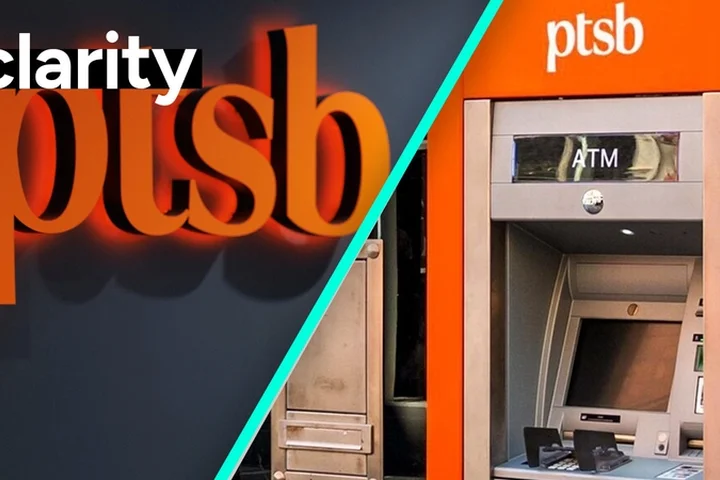
Amid feverish late-night negotiations 18 years ago, the then government, a coalition of Fianna Fáil and the Green Party, made a monumental decision to rescue Ireland's drowning banks.
It was September 2008 and the global financial crisis had erupted, exposing Ireland's banking untouchables, incompetent regulators and cavalier politicians.
The taoiseach at the time was Fianna Fáil’s Brian Cowen and the minister for finance was his party colleague, the late Brian Lehihan, who was only five months in the job.
Late on 29 September, bankers, regulators and politicians hastily gathered in Government Buildings.
At 7am the following morning, RTÉ broke the news that a decision was made to guarantee the €400 billion of liabilities of the banks.
From that point onward, the fate of Irish taxpayers and banks was inextricably linked.
In the following two years, Ireland's financial institutions crumbled as it became clear they had lent huge sums to developers and builders which would never be repaid.
As their losses mounted, the taxpayer poured €64 billion into Bank of Ireland, AIB, Anglo Irish Bank, Irish Life & Permanent (owner of PTSB) and two building societies EBS and Irish Nationwide.
The State took control of the banks, but its intervention coincided with a collapse in the public finances.
Ireland bailed out the bankers - and the bill was so large the country had to be bailed out itself by the European Union and the International Monetary Fund.
By late 2010, the State was being run by technocrats from Washington, Brussels and Frankfurt.
Taxes shot up, unemployment soared and tens of thousands emigrated in search of work abroad.
The State finally gets out of banking
Fast forward 18 years and Ireland is a prosperous country.
This week, the current Government of Fianna Fáil, Fine Gael and Independents agreed to finally get out of the banking business.
At a Cabinet meeting on Tuesday, ministers were told by Minister for Finance Simon Harris that he was going to sell the State’s 57.5% stake in PTSB bank.
It sold its stakes in Bank of Ireland and AIB in recent years.
In October last year, PTSB’s board and Paschal Donohoe, who was then minister for finance before joining the World Bank in November, agreed to put the bank on the market.
Goldman Sachs advised PTSB, while Rothschilds was hired by the Government.
Six bidders were interested, whittled down to four, and then three.
Critically, the only bank in the final bids was BAWAG.
Selling PTSB to a private equity company could have been politically problematic for the Government if, or when, the new owner decided to aggressively cut staff numbers.
When news broke just before noon on Tuesday that BAWAG was chosen as the preferred bidder, Simon Harris emerged from Cabinet and quickly did a round of media interviews in the Department of Finance boardroom.
In his interview, Mr Harris talked up the benefits of the deal.
"It means the State has recouped the investment it made in PTSB and when you look at the three banks overall - Bank of Ireland, AIB and PTSB - the State has recouped that money but also beyond that too," he said.
"In any sale, any asset is valued at what the market is willing to pay for it.
This was a very robust, very transparent and a very comprehensive sales process," he said.
On the face of it, that sounded like a good deal.
But was it?
We need your consent to load this flourish content We use flourish to manage extra content that can set cookies on your device and collect data about your activity.
Please review their details and accept them to load the content.
Manage Preferences
Was selling PTSB for €1.6 billion a good deal?
Denis McGoldrick, a banking analyst with Goodbody Stockbrokers, said the deal is a "disappointing outcome relative to my initial expectations".
BAWAG is buying the bank for €1.6 billion which is less than the value of PTSB's balance sheet - it suggests the bank is worth €2 billion.
There is also a significant regulatory change under way, which will benefit the bank in the next 12 months.
The Central Bank is currently reviewing how much capital banks need to hold in relation to the mortgages they lend.
PTSB is obliged to hold more capital than any other bank in Europe and is widely expected to benefit from a loosening of current restrictions.
"The timing struck me as a little premature for the Government and PTSB to put itself up for sale last October in advance of that," said Mr McGoldrick.
The regulatory change was something "we all knew was going to be very positive for the bank," he added.
He said the stock market turmoil caused by the Iran war may have also weighed on the price.
It is very possible PTSB could have been sold for a higher price next year.
But there are wider considerations which the Government had to take into account.
EU policy is for the State to remove itself from sectors where private companies compete, such as telecoms and banking.
BAWAG's entry into the market means more competition for AIB and Bank of Ireland which will ultimately benefit customers.
It is also healthy for the sector to have an Austrian bank enter the market after foreign-owned Ulster Bank and KBC pulled out.
What will it mean for customers and employees?
The takeover is not expected to be finalised until the end of the year.
For customers, existing agreements such as fixed rate mortgages or savings products won’t be altered.
Terms and conditions for the 2,900 staff will also continue.
The bank recently completed a redundancy programme.
There is speculation that the new owner is likely to continue to reduce costs.
The bank's 98 branches have been pivoting from transactions to providing advice on new products.
That trend is likely to continue.
Did the taxpayer get all its money back from the banking bailout?
Minister Simon Harris is correct to say the State has recovered its money collectively from PTSB, Bank of Ireland and AIB (which owns EBS).
If payments from the bank levy tax are included, more than €4 billion was recouped in total.
However, it is questionable whether tax payments should be included.
But it's not the full story of the bailout.
This week the Department of Finance did not mention Anglo Irish Bank and Irish Nationwide.
They were the most egregious institutions during the boom and received a total state bailout of €34.5 billion.
Of that, just €1.1 billion was recovered.
Both were liquidated.
The remaining €33.4 billion will never be seen again.
Related Stories

Source: This article was originally published by RTÉ News
Read Full Original Article →
Comments (0)
No comments yet. Be the first to comment!
Leave a Comment