
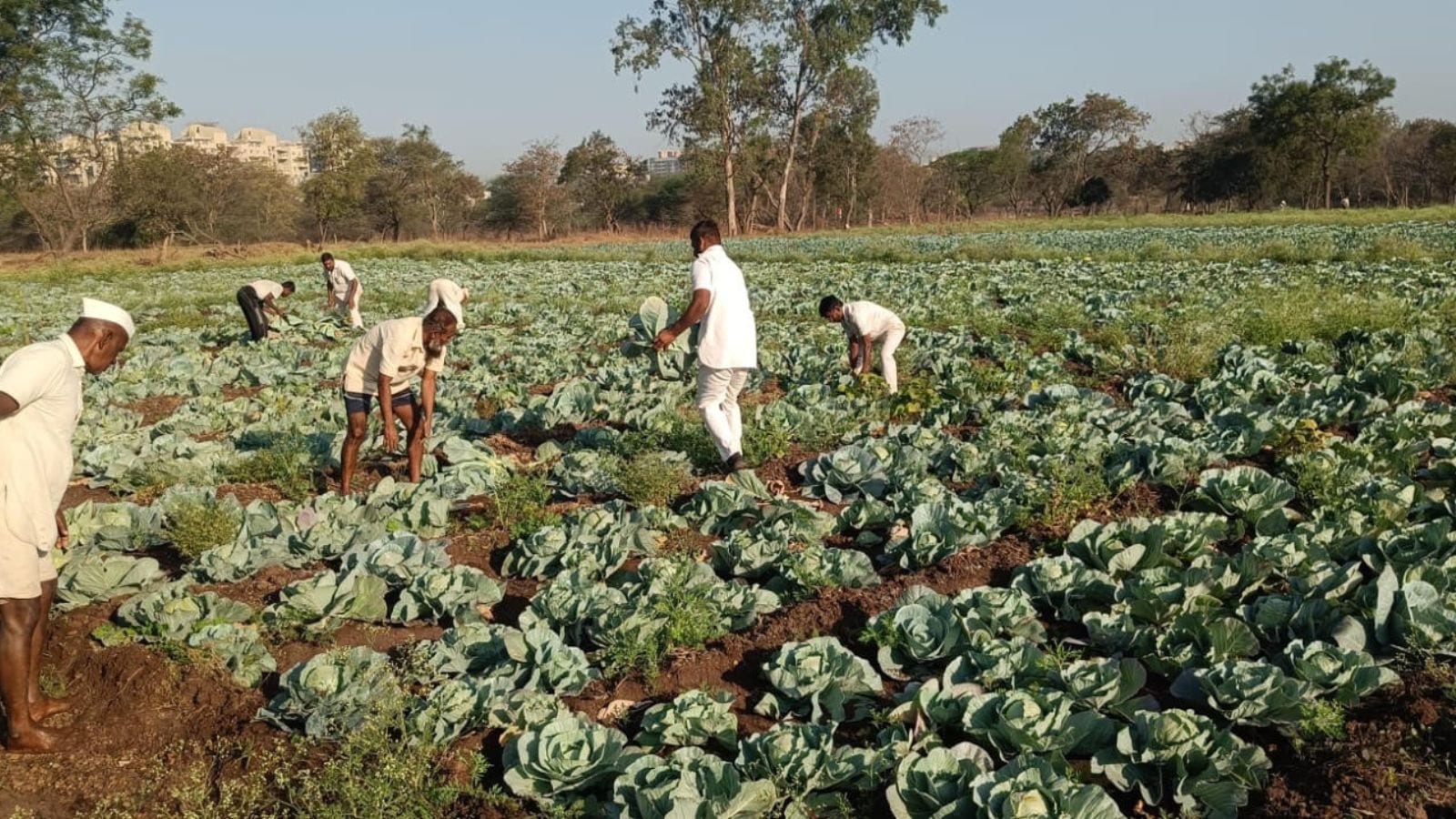
The Yerawada Open Prison, home to just over 200 inmates, has become the primary green grocer for the sprawling, maximum-security Yerawada Central Prison.
By supplying fresh vegetables to over 6,000 prisoners next door, the facility highlights a unique correctional initiative centred on self-sufficiency and rehabilitation.
The oldest among the 19minimal security open prisonsin Maharashtra, established in 1956, Yerawada Open Prison owns over 250 acres of land inPune’s prime Yerwada area, of which close to 100 acres are under cultivation, including vegetables, grains, fruits, and fodder for animals, while the remaining is used for animal husbandry.
The open prison is also implementing a major afforestation project on a section of this land.
Inmates here are more than just prisoners; they are farmers, poultry breeders, and craftsmen.
Beyond the fields, they staff the prison printing press, a laundry service, a hairdressing salon, and a goods sales centre.
In August 2023, the prison department even launchedShrunkhala Upahargruha, a restaurant fully designed, built, and managed by the inmates.
For their labour, inmates receive a prescribed daily wage deposited into personal accounts.
These earnings are used for daily necessities at the jail commissary, sent home to families, or saved for legal expenses.
All accumulated savings are handed over to the inmates upon their release.
“Agriculture lies at the heart of the open prison philosophy,” said Shamkant Shedge, Superintendent of Yerawada Central Prison.
“It provides meaningful, productive work in a less restrictive environment.
By maintaining farmland, prisoners develop discipline and responsibility.
It builds a sense of purpose that prepares them for reintegration into society.”
Among the vegetables that the open prison grows round the year are cauliflower, spring onion, tomato, spinach, amaranth, brinjal, radish, potato, onion, dill, chilli, cabbage, along with coriander, ginger, garlic and curry leaves.
Out of 100 acres under cultivation, well over 25 acres are used for vegetables.
In December last year, the owner of the open orchard started growing broccoli on a half-acre plot and sold it in the open market.
The facility is also planning to start cultivating strawberries, lettuce, and purple cabbage.
While only a small portion of these vegetables is sold at the Shrunkhala restaurant, most are supplied to Yerawada Central Prison.
“Every day, the open prison supplies 400 to 700 kg of fresh vegetables to Yerawada Central Prison, depending on what we are sending.
We plan cultivation to sustain this supply year-round.
We have a dedicated agriculture officer who helps with planning.
We have three reservoirs on our land and they take care of the irrigation.
Our 100 cattle, 100 goats take care of the majority of the fertiliser requirement.”
Central Prison Superintendent Sunil Dhamal said, “Our almost entire requirement of fresh vegetables is taken care of by Yerawada Open Prison.
On some days, we also take some fresh vegetables from Visapur and Paithan open prison.”
Interestingly, open prison farms have 68 huge tamarind trees, the produce of which is sold in the open market.
“We are now planning a plantation of Kesar Mangoes and Sardar Guavas, 50 plants each, in the coming months to increase our fruit yield,” Shedge added.
The idea of having minimal-security open prisons was deliberated extensively in the mid-1950s at various international forums.
In the late 1950s, a committee set up by the Union government to revise the prison rules established guidelines for the creation of open prisons in India.
The first open institution for convicts was started as an annex of Yerawada Central Prison in 1956.
The second open prison facility was established at Paithan, in Aurangabad (now Chhatrapati Sambhajinagar), in 1968.
The Paithan facility was the first separately located open prison in Maharashtra and was considered an important landmark in the history of the state’s prison administration.
Maharashtra now has as many as 19 open prisons, the second-highest number in India afterRajasthan, which has 31 open correctional facilities.
Maharashtra’s 19 open prisons include two for women, one at Yerawada in Pune and the other at Akola.
The 19 open prisons have a total capacity of over 3,300 and currently house over 3100 inmates.
The Yerawada Open Prison for male inmates currently houses around 200 inmates, and the open prison for women at Yerawada houses around 60 inmates.
The selection process for transfer to an open prison in Maharashtra is stringent and involves detailed screening by a committee of senior prison officials.
Inmates are evaluated on multiple factors, including health, behaviour, discipline, work progress, and trustworthiness, and their cases are reviewed regularly to ensure that only those who meet strict standards remain in the open prison system.
Sushant Kulkarni is a Special Correspondent with The Indian Express in Pune with 12+ years of experience covering issues related to Crime, Defence, Internal Security and Courts.
He has been associated with the Indian Express since July 2010.
Sushant has extensively reported on law and order issues of Pune and surrounding area, Cyber crime, narcotics trade and terrorism.
His coverage in the Defence beat includes operational aspects of the three services, the defence research and development and issues related to key defence establishments.
He has covered several sensitive cases in the courts at Pune.
Sushant is an avid photographer, plays harmonica and loves cooking....
Read More
Related Stories



Source: This article was originally published by The Indian Express
Read Full Original Article →
Comments (0)
No comments yet. Be the first to comment!
Leave a Comment