
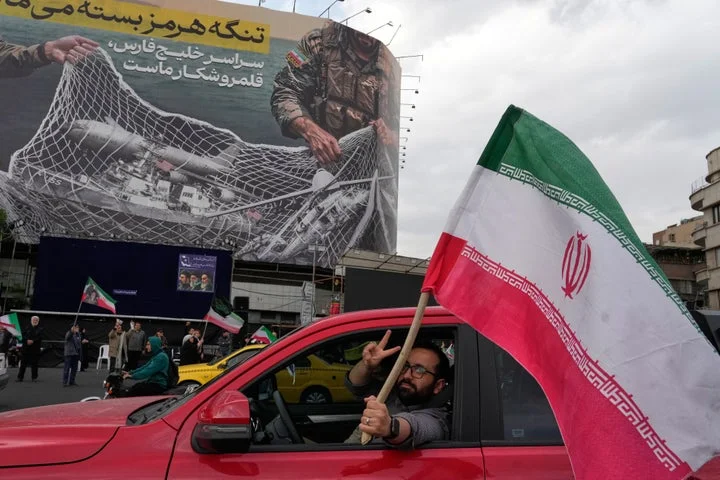
A blockade of Iranian ports that President Donald Trump said began Monday could further disrupt oil prices
Trump threatened to impose the blockade after talks to further a fragile ceasefire ended without a deal this past weekend.
Iran had previously halted nearly all tanker traffic through the key waterway, allowing only some ships perceived as friendly to pass while charging considerable fees.
Enforcing the blockade is likely to demand significant resources from the U.S.
Navy and could prompt concerns about military force and international law, experts say.
Supply chain analysts, meanwhile, stress that the restrictions could undermine the flow of oil, fertilizer, food and other goods to consumers already facing higher prices.
How the US could enforce a blockade of Iranian ports
Successfully enforcing the blockade will require sustained commitment of U.S.
Navy ships and personnel, as well as clear guidance from the Trump administration and the Navy’s legal department, experts say.
From a military standpoint, the biggest challenge will be the enormous volume of shipping traffic transiting the Strait of Hormuz, where nearly 20% of the world's traded oil normally passes.
A considerable number of ships may be needed to enforce the restrictions, according to Sidharth Kaushal, a naval power expert at the Royal United Services Institute, a defense and security think tank in London.
“A lot depends on the early days of the blockade, how many vessels the Americans can seize, how much they can convince vessels attempting to slip through a cordon that they’re likely to be seized,” Kaushal said.
“But in all likelihood, I’d say it will prove difficult for the U.S.
to enforce.”
The strait’s narrow confines at least will make the geographic area of concern a limited one, said Todd Huntley, director of Georgetown University Law Center’s National Security Law Program.
Still, the amount of traffic that goes through “is going to be a challenge,” he said.
The U.S.
may have to consider whether to allow humanitarian aid to reach Iranian ports, Huntley said, a decision that could determine the blockade’s legality under international law.
International rules also require that any nation enforcing a blockade do so impartially, after issuing an advisory to mariners.
“How it is carried out will determine whether it is lawful or not,” said Huntley, a retired Navy captain and judge advocate general.
“You can’t enact a blockade with the goal of starving the civilian population.
Even the DOD law of war manual states that neutral vessels carrying relief supplies should be allowed to pass.”
Few merchant vessels are likely to try to evade a blockade, according to Raul Pedrozo, professor of international law at the Naval War College and a retired Navy captain and JAG officer.
They won’t want to take their chances against the U.S.
Navy, he said.
“They see a warship, and they’re going to heave to,” Pedrozo said.
Naval blockades aren't a fix-all but can be a tool
Blockades historically haven’t been enough on their own but have been used to exert pressure on other countries and their economies during conflicts, experts say.
“There are always ways to economize, import, substitute, or just give up on certain things that you can no longer build for want of foreign inputs," Kaushal said.
"It can make things a lot harder in a lot of ways, but it doesn’t necessarily achieve decisive outcomes.”
A blockade alone can’t sever Iran’s economic ties with trading partners, including China and Russia, or cut off access to the Caspian Sea or Central Asia .
The blockade also risks an Iranian response that could reignite the conflict, said Farzin Nadimi, who specializes in Iran and the Persian Gulf at the Washington Institute for Near East Policy.
Iran could deploy naval mines, small fast-attack boats and missiles against shipping in response, further disrupting the global economy.
“The U.S.
wants this to be a short and sweet operation.
I don’t think that it can be,” Nadimi said.
Trump said Iran has some “fast attack ships” remaining and warned Tehran that any of them coming “anywhere close” to the U.S.
blockade would be destroyed by a “quick and brutal” strike.
Iran responded with its own threats on ports in the Persian Gulf and Gulf of Oman.
With fears of attacks, experts say most ships won't want to take the risk.
The waterway could effectively stay shut — and prices, particularly for oil and gasoline, could rise even more.
Halting roughly 20% of the world’s flow of oil has already led to cuts from some major producers in the region, because their crude has nowhere to go.
“The problem with a two-side blockade is that you know it’s going to take much longer for the strait to open up and for some kind of agreement to come about — and that’s what's going to send these prices further skyrocketing,” said Vidya Mani, a visiting associate professor at Cornell University whose research focuses on supply chains.
Analysts warn that the longer the waterway is closed, the worse prices could get.
Oil has swung on markets' quick reactions to announcements from Trump and others about the fate of the war, but they remain steep overall, with crude trading Monday above $100 a barrel, up from roughly $70 before the war.
Households and businesses are paying the consequences — particularly in Asia, where countries rely more heavily on fuel imports from the Middle East.
But oil is a globally traded commodity, and consumers worldwide are feeling a pinch in their wallets.
American drivers, for example, have seen gas prices spike to an average of more than $4.12 a gallon — up from $2.98 before the war.
Global supply chains also could see further disruptions
The blockade also would hurt the transportation of food and fertilizer, said Patrick Penfield, professor of supply chain practice at Syracuse University.
He said the United Arab Emirates, Qatar, Bahrain and other countries could especially see “dramatic food price increases,” as supplies will have to be flown in.
Some 30% of the world's fertilizer also comes through the strait, potentially harming farmers and as a result worsening hunger worldwide.
“Now you’re talking about impacting the global harvest,” Penfield said.
Between these disruptions and oil shocks, he noted that such chaos and uncertainty “bleeds out throughout the whole world.”
Mani said chemicals to make basic supplies like paint and metal, including aluminum, would see additional disruptions.
She pointed to price pressures even before the U.S.
and Israel launched their war against Iran — including new tariffs imposed by Trump, supply chain problems from the COVID-19 pandemic and other geopolitical conflicts.
“We just have to be prepared for constant higher prices, irrespective of how this blockade turns out,” she said.
“Each crisis has a lingering effect on the next one.”
AP Business Writer Mae Anderson contributed to this report in New York.
Related Stories



Source: This article was originally published by The Independent
Read Full Original Article →
Comments (0)
No comments yet. Be the first to comment!
Leave a Comment