
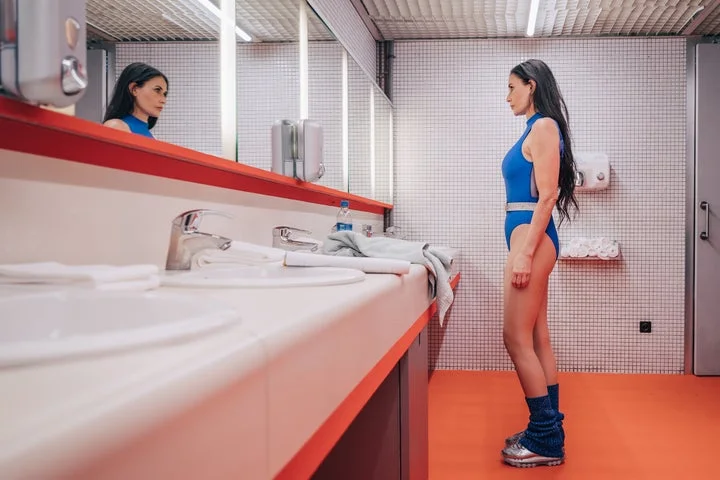
Weight-loss drugs turn food noise down, but it can be replaced by something far more disturbing.
As the so-called ‘skinny epidemic’ shows up on red carpets and in social media transformations, Lydia Spencer-Elliott asks the experts how to quieten the voice inside her head telling her she’s not small enough
L ook how chubby your thighs are.
How could you leave the house in that skirt?
Your hips are huge.
Your stomach is spilling out.
Suck in your gut.
Lift up your jaw.
Her arms are skinnier than yours.
You could never wear those jeans.
If a friend spoke to you like this day in, day out, you might punch them in the face within a week.
But this is how I used to speak to myself, all the time, until rounds of therapy worked on my intrusive thoughts, self-esteem and disordered eating as a young adult.
It was gruelling, but I got there and enjoyed years unplagued by the bully in my head.
Then, as weight loss jabs emerged, the voice got louder again.
Everywhere you turn, people are shrinking.
From Ariana Grande’s visible sternum on the Wicked red carpet, to Emma Stone’s pronounced shoulders at this year’s Baftas, bone has become the beauty standard , and while I spent half a decade in recovery, a healthy weight , and more than happy with how I looked, there’s now an overwhelming feeling that I’m somehow in the wrong; that I should look emaciated, too.
I’m not alone in these thoughts.
On TikTok, users have coined the resurgence of what was dubbed “heroin chic” in the Nineties “skinny epidemic”.
“What’s more terrifying this time around is that it’s encouraging young people to take medicine in order to achieve this kind of body,” says 27-year-old content creator Grace Rosborough.
“But it’s an unhealthy body – and an unhealthy way to achieve it.”
In the 2010s, it was a thing among teenage girls to browse so-called “thinspo” (thin inspiration) content on microblogging sites like Tumblr.
Around 2012, the body positivity movement largely stamped that out, with creators instead posting pictures with captions like “strong, not skinny” as they promoted muscle growth and protein shakes rather than thigh gaps and clavicles.
“I’ve seen a lot of body positive creators sharing that they’ve lost a lot of weight,” says Rosborough of the return of thinspo to social media.
“I don’t want to say they’ve gone against what they created a platform for, but it’s very obviously taken a turn.”
Rosborough decided to make a video speaking out against thinspiration on TikTok after she unintentionally became it herself.
“I wasn’t trying to lose weight at all.
I was just going through a really rough time,” she says.
“That’s what made it even scarier.
Why was I so well liked when I was essentially killing myself?
Then it makes you think, ‘Do I stay skinny to be liked?
Or do I actually make myself healthy again?’ It’s terrifying.
The algorithm will always push diet culture videos every once in a while, even if you scroll past them.
It’s a big mental game with yourself to keep telling your brain, ‘that is not what I should look like.’”
In the 2010s, I allowed these thoughts to push me towards disordered eating and bulimia.
Today, I’ve (thankfully) had enough cognitive behavioural therapy and counselling to tell my internal monologue off like a child and apologise to myself.
Still, that doesn’t make the self-deprecation any less draining.
I want the voice to go quiet again.
But it’s hard when thinness is everywhere – and the visibility of regular bodies is diminishing at a disturbing rate.
Just 15 per cent of UK TV and digital adverts featured diverse body types in 2025, for example.
This is almost half of the 28 per cent recorded in 2024.
Where will we be by 2030?
“Comparative thinking is so common in eating disorders,” says Deanne Jade, psychologist and director of the National Centre for Eating Disorders.
“It’s like having a poisoned parrot on your shoulder that tells you that you’re not good enough.
But having poor body image is now normal in our society.
There are so many ostensibly beautiful or [so-called] ‘perfectly slim’ people out there – and you’re directed to them every single day on the TV, on social media, wherever, that people stigmatise themselves all the time.
We need to press a reset button.”
Sana Khwaja, therapist for BetterHelp, recommends taking a moment to consider whose voice your poison parrot is mimicking.
“Ask yourself, ‘whose voice is that?
Where has it come from?
Where have I heard it before?” she says.
“It could be your friend, mum, auntie – or even a conversation between cast members on The Kardashians where they’re all sat there with their salads and Scott Disick is opening his fridge full of Mounjaro.
It’s become part of a lifestyle that’s being sold to us – that this is what we should be doing.”
There are friends I’m struggling to spend time with because they’ve dropped dozens of kilos out of the blue.
Looking at them, I feel a strange mixture of deep concern, spiky jealousy and intense shame
Jade’s first tip is to simply stop looking if you can.
“When you’ve become very well practised at not approving of yourself, you become like an addict for the very thing that’s driving you insane,” she says.
“There’s no difference between people who’re taking drugs and alcohol and whatever media you’re endlessly drawn to.
So, you’ve got to make this decision.
If this is contributing to your angst, can you stop doing it?”
Khwaja concurs: “On TV, we see jarring content in short bursts, then we go back to our normal life and see normal people with regular bodies at the spa or in the supermarket or at the gym.
Whereas it’s constantly on our phones.
We need to be mindful of our feeds and get rid of the things that don’t make us feel good.
Then, get out into the real world and realise that nobody looks like those pictures – even the people in the pictures.”
Eating disorders are famously competitive.
So, sufferers or those in recovery can often get triggered by someone close to them losing weight – whether by Ozempic or natural means.
In recent months, there have been friends I’m ashamed to say that I’ve struggled to spend time with because they’ve dropped dozens of kilos out of the blue.
Looking at them, I feel a strange mixture of deep concern, spiky jealousy and intense shame.
Khwaja says there’s no point ignoring those feelings – even if you’re deeply embarrassed by them.
“You have to be super honest,” she says.
“There’s no such thing as a bad feeling.
It’s OK that we feel envy, judgement, or upset.
Don’t deny those feelings.
They give you room to look at what your core beliefs (‘people won’t love me unless I look like that’) are telling you versus the actual truth about your friends and family.”
“I treated one lovely woman who worked with someone who was losing a significant amount of weight,” recalls Jade.
“I asked her how she felt about it and she said, ‘I want to break both of her legs’.
But the thing is, you have to be careful who you envy.
I used to be jealous of a close friend who had three children and was a size six within a week of giving birth.
I was so envious.
Then she died of breast cancer when she was 38.”
Recent studies have found that those using weight-loss jabs are likely to regain two-thirds of the weight they lose within a year of stopping the medication.
Simultaneously, some users have reported losing their sight and suffering from extreme vomiting while on the drugs.
In 2024, one Californian woman, Marsha Ettinghoff, 76, died six months after she started taking Ozempic .
“I didn't think that she needed it, but she wanted to be on it,” her husband, who’s suing the company, said this month.
“Comparison is a very specific kind of hell,” reflects Jade.
“I tell patients to take a breath and say, ‘stop, I’m OK the way I am’.
If you practise that, it won’t feel true in the beginning – or even the first 30 times you say it – but the 50th time it’ll become more true.
So, you can hear that voice saying you don’t look good enough, but eventually it will matter a little bit less.
It’s the muttering that’s the problem – not so much the body.”
Join thought-provoking conversations, follow other Independent readers and see their replies
Related Stories


Source: This article was originally published by The Independent
Read Full Original Article →
Comments (0)
No comments yet. Be the first to comment!
Leave a Comment