
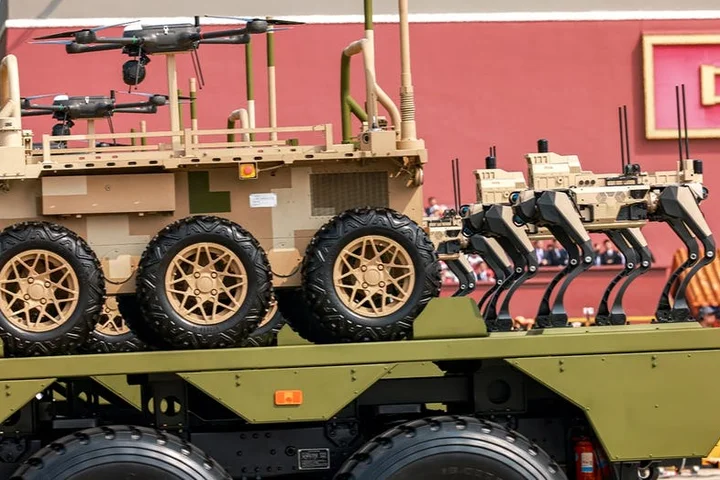
China is developing AI-enabled robotic "wolf packs" designed to scout, supply and potentially support combat operations alongside troops in a future war — including a possible invasion of Taiwan — according to a new report.
The analysis from the Foundation for Defense of Democracies (FDD) says Beijing is reshaping how wars can be fought by integrating artificial intelligence, robotics and autonomous systems directly into frontline operations.
At the center of that effort are quadruped robots — often referred to in Chinese reporting as "robotic wolves" — that the People’s Liberation Army (PLA) is testing as part of its push toward what it calls "intelligentized warfare."
While China has showcased robotic dogs in recent years, the report argues the People’s Liberation Army is moving beyond demonstrations and beginning to integrate these systems into coordinated battlefield units designed to operate at scale — particularly in high-risk scenarios such as the opening phase of a Taiwan invasion.
CHINA LAUNCHES CENTER TO TRAIN 100-PLUS HUMANOID ROBOTS SIMULTANEOUSLY
The report warns that a force built around expendable, networked machines could allow Chinese commanders to sustain offensive operations while reducing risks to personnel, potentially lowering the political and military costs of conflict for Beijing.
"China is not just modernizing its military," the report states.
"It is reimagining how future wars will be fought."
The U.S.
military is also developing robotic and autonomous systems, though analysts say China’s ability to leverage its commercial technology sector could give it advantages in scaling production.
In testing and demonstrations cited in the report, the robotic systems are used primarily for reconnaissance and support roles, moving ahead of troops to map terrain, detect threats and carry supplies through hazardous areas.
The quadrupeds can navigate difficult terrain, including stairs and debris-filled urban environments, and operate in coordinated groups to extend a unit’s reach.
Some Chinese reporting also depicts armed variants operating alongside troops and drones during simulated assaults, though many of these capabilities have not been independently verified.
The report identifies a potential conflict over Taiwan as the most likely scenario for deploying the systems.
An amphibious invasion would force Chinese forces to operate in dense urban terrain, contested coastal zones and degraded communications environments — conditions where unmanned systems could be used to clear routes, absorb initial losses and maintain momentum as troops push inland.
Despite the rapid development, the systems face limitations.
They rely on communications links and battery power, making them vulnerable to jamming, cyber interference and logistical disruptions.
They are also susceptible to small arms fire and environmental conditions such as smoke or debris that can degrade sensors.
The report notes that human operators remain in the loop for lethal decisions, limiting the systems’ autonomy in combat.
The report calls on U.S.
policymakers to prioritize countering China’s autonomous systems, including developing strategies to disrupt robotic platforms and strengthening domestic technology capabilities.
Analysts warn that as unmanned systems become more integrated into combat operations, they could shape the pace, risk and outcome of future conflicts.
Related Stories



Source: This article was originally published by Fox News
Read Full Original Article →
Comments (0)
No comments yet. Be the first to comment!
Leave a Comment