
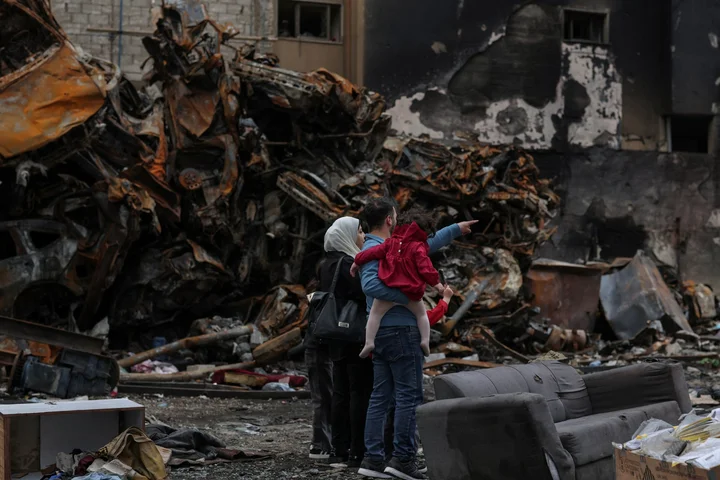
US confirms second round of negotiations between the two countries as the Israeli military annihilates Lebanese towns.
The United States will host a second round of talks between Lebanon and Israel on Thursday, the US Department of State has confirmed, as the two countries push on with direct negotiations amid regional tensions.
The talks, which will take place at the State Department, will be the first since a fragile ceasefire came into effect between Hezbollah and Israel last week.
“The United States welcomes the productive engagement that began on April 14,” a State Department spokesperson told Al Jazeera.
“We will continue to facilitate direct, good-faith discussions between the two governments.”
Lebanese and Israeli officials met last week for the first time in decades, sparking anger from Hezbollah and its allies.
But after the ceasefire came into effect, Lebanese President Joseph Aoun reasserted on Friday that Beirut will continue on the path of negotiations with Israel.
“These negotiations are not a weakness.
They are not a retreat.
They are not a concession,” Aoun said in a televised address.
“They are a decision stemming from the strength in our belief in our rights and care for our people, and our responsibility to protect our country by all means possible.”
Hezbollah has described the talks as part of a series of “losing concessions” that the Lebanese government is making to Israel.
“We reject the negotiations with the occupying Israeli entity.
These negotiations are futile.
These negotiations require a Lebanese consensus on changing direction,” Hezbollah chief Naim Qassem said last week.
“No one has a right to take Lebanon towards that approach without internal consensus among its components, which has not happened.”
Lebanon’s ambassador to the Washington, Nada Hamadeh, and her Israeli counterpart Yechiel Leiter led the first round of talks on April 14, which was also attended by US Secretary of State Marco Rubio.
The talks came less than a week after a massive Israeli wave of air strikes across Lebanon, including the capital Beirut, that killed more than 300 people, including medics, women and children.
When Trump announced the ceasefire on April 16, he said he would invite Aoun and Israeli Prime Minister Benjamin Netanyahu to the White House.
“Both sides want to see PEACE, and I believe that will happen, quickly!” Trump said.
Aoun said on Wednesday that Lebanese diplomat Simon Karam – a former envoy to the US – would lead the negotiations for Beirut.
Despite the ceasefire, Israel has continued to blow up neighbourhoods in border villages in south Lebanon to create an annihilated area it is calling a “forward defence” line.
Israeli officials have openly said they aim to replicate the destruction of entire towns in Gaza in southern Lebanon.
Aoun has vowed that his government will work towards full Israeli withdrawal from Lebanon without sacrificing any part of the country’s territory.
The Lebanese government has pushed to separate Lebanon from the broader negotiations between the US and Israel, arguing that only Beirut can negotiate for itself.
However, Iran has stressed that Lebanon must be included in the broader truce.
On Friday, Trump said he “prohibited” Israel from attacking Lebanon.
But Israeli attacks, including the razing of civilian infrastructure in the south, have continued.
Israel said it killed “terrorists” operating in the city of Bint Jbeil in southern Lebanon on Monday.
For its part, Hezbollah said it detonated an explosive device against a convoy of Israeli military vehicles near the town of Deir Siriane in the eastern sector of the border.
Related Stories


Source: This article was originally published by Al Jazeera English
Read Full Original Article →
Comments (0)
No comments yet. Be the first to comment!
Leave a Comment