
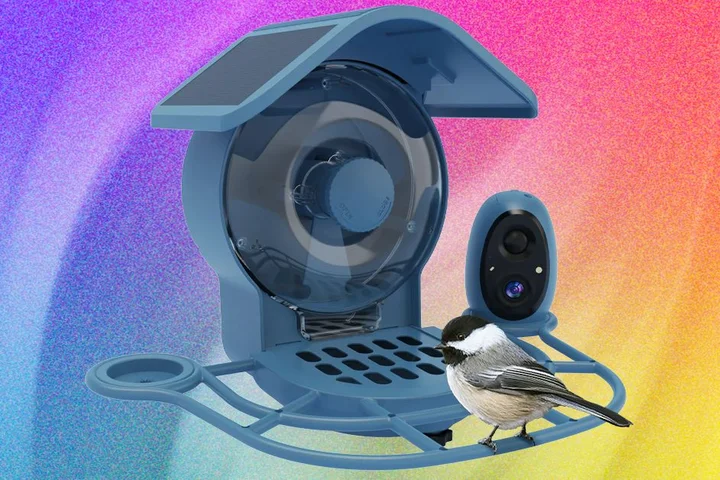
The bright-blue plastic, curvy Aura, which debuted at CES 2026 with claims of sporting the world's first modular smart feeder camera system, doesn't really look like a bird feeder.
If someone showed me a picture, I'd probably guess it was an anthropomorphic drone from Sesame Street or something the Octonauts would pilot to go visit the Great Barrier Reef.
It won’t exactly blend into your yard.
But, function-wise, it certainly checks a lot of boxes and offers AI identification without needing to spring for a separate subscription, a rarity among smart feeders.
Assembly was quick and tool-free, requiring only a handful of included knob screws.
I also like that it included both fence- and pole-mounting options, the latter of which is critical for preventing squirrel damage .
Smart feeder companies continue to upgrade their cameras' quality with each new model , but the general range still seems to be anywhere from 1080p photos and 2K video on the low end (as with the Birdfy Lite ), all the way up to 32-MP photos and 4K video (as with Camojojo's new Hibird Pro ).
The Aura falls somewhere in the middle of this range, with 4-MP photos and a respectable 2.5K Ultra HD video.
The camera's 150-degree field of view is wider than that of a typical bird feeder camera, and it helps to capture all angles of what's really the Aura's signature feature—a wraparound perch with little platforms on the left and right sides, where you can position the camera upright (which shows pictures in a horizontal "landscape mode") at the angle you prefer.
If you want the camera to be on its side (vertical "portrait mode"), there's a little adapter that connects to the back and screws into the platform.
Do note, though, that despite some marketing photos showing the Aura with two cameras, it only comes with one camera, and when it's on its side, it can only be mounted on the right side of the perch.
Portrait mode (the camera mounted on its side) allows for greater detail in photos, but it wasn't always successful at capturing all the action, depending on where a bird stood.
The biggest issue with this camera orientation, however, is that the app's AI identification doesn't work with it.
I asked Coolfly if this was an error, but it turns out it's how the camera was designed.
“To offer users ‘Limited Free AI' without monthly subscription fees, our bird ID algorithm is hardcoded directly into the device's hardware,” Coolfly's rep told me.
“Because this on-device neural network was trained exclusively on horizontal datasets, physically flipping the camera … disrupts the local algorithm's spatial mapping.”
The solution?
“If our users shoot vertically and spot an unknown bird, they can simply take a screenshot and send it to our in-app ChirpChat feature.
Our interactive AI assistant will identify it perfectly from the image," Coolfly's rep said.
Though this step was cumbersome, it did correctly identify nearly all of the birds I proffered (as did the built-in AI ID).
I liked seeing the birds slightly closer up with the side camera orientation, but it wasn't a dramatic difference between the views.
Certainly not dramatic enough to justify the hassle of losing the AI ID or of having to go out and fiddle with taking the camera on and off its little mount to switch modes.
So for the majority of testing, I kept the camera in its default upright position.
The Aura uses the Coolfly app, which isn't as intuitive as some of the bigger brands’ apps, like Birdbuddy's, but it was perfectly usable.
There's the ChirpChat, a bird search, and a Facebook-esque “social feed” where you can follow other Coolfly feeder users and see their posted videos and images.
(Note that there were only about 10 users total at the time of my test.)
What I liked the most about the app was that it immediately IDs all the bird captures in the album with a little bird-head icon of that species.
It helped me visually sort at a glance which visitors were new and noteworthy that day, and clicking the icon leads to an informational page on the bird, as well as a sound clip of the species' typical call, so you can see if you've heard it around.
What I liked the least, however, was the number of marketing push notifications the app would send, for sales and other irrelevant topics.
It became so irritating, in fact, that I ended up turning off notifications altogether, which meant I was only aware of bird activity if I went into the app.
The Aura also has one of the more unusual seed hoppers I've come across—a spherical 1.8-liter receptacle that sits at the center of the feeder and can be inserted and removed without unmounting the whole device.
The knob on the front opens and closes a hopper at the bottom.
Fill it up, place it in the center, and open the hopper for the seed to flow out into the tray.
Well, supposedly.
When I did this the first time, only a couple of tablespoons of seed flowed out, and most of it was obscured by a thick metal squirrel (I assume) guard that sits atop the seed tray.
In fact, it was only after a couple of days without bird activity that I noticed many birds, especially smaller ones like chickadees, were struggling to access the seed at the bottom of the tray through this metal guard.
I ended up removing it.
As for the rest of the features, the touted “color night vision” is, as on many other feeders, simply a motion-activated white LED that shines on the perch, and the built-in solar was reliable, though a little finicky in Pacific Northwest late-winter/early-spring clouds.
(However, I will note the 5200-mAh battery is still somehow holding a charge in my office, weeks after testing wrapped up.)
Is this feeder worth its $290 MSRP?
(Or even its $220 sale price?) If, for some reason, you have a specific need for the Aura’s modular camera system, maybe.
But for most people, this is going to be a middling novelty, not a necessity, especially factoring in the loss of AI ID in one of the modes.
At this price, you can get sharper cameras, better apps, and more polished ecosystems elsewhere.
The Aura is definitely interesting and different, but I can't help but feel it's trying to solve a problem that didn't exist in the first place.
Related Stories



Source: This article was originally published by Wired
Read Full Original Article →
Comments (0)
No comments yet. Be the first to comment!
Leave a Comment