
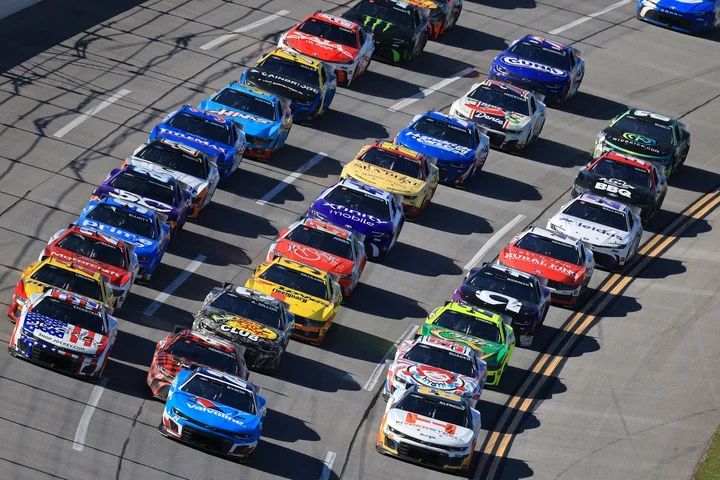
NASCAR has adjusted the length of the three stages for the Cup Series race at Talladega on April 26.
The first stage will end on Lap 98, the second stage on Lap 143 and the scheduled conclusion on Lap 188.
In comparison, last year saw the stages end on Lap 60 and 120.
In other words, NASCAR has structured the race where fuel will not be necessary in the middle of the final two stages, to discourage fuel conservation tactics.
This has been a point of contention from the fan base and some drivers since the current-generation car made its debut in 2022.
Teams instruct drivers to run at half-throttle or less at Daytona and Talladega right now because passing is considerably challenging for this car compared to its predecessors on these types of tracks.
If the amount of drag and aero prevents passing within the pack, the only other optimal way to gain track position is to get it on pit road, by being able to take less fuel than other teams.
In order to take less fuel on pit road, a driver would need to use less while racing.
Read Also:
NASCAR Preseason Thunder returning with goal of better superspeedway racing
NASCAR also intends to schedule a winter test at Daytona, similar to the old Preseason Thunder, to work on additional aerodynamic package changes to the hopes of improving the racing product itself.
John Probst, NASCAR Executive Vice President and Chief Racing Development Officer, discussed those changes last week on the official NASCAR ‘Hauler Talk’ podcast.
“Coming out of Daytona we have been working hand-in-hand with a lot of our race teams trying to largely break into two categories things we could do.
One are sporting related things, things like rules around pit stops or stage lengths or things of that nature.
The other being in a technical bucket, which would mean car changes: spoiler, power level, things of that nature….
“As we went through all of our options, not just with NASCAR but even with the teams, there’s a little bit of reluctance to just make wholesale changes to any of the technical stuff in the middle of the season for fear of the unintended consequences.
“If you look at generally how a lot of our speedways were laid out it was a short stage, a short stage and then a long stage to the end.
Going into Talladega, we’re going to flip that and adjust the lengths of the final two stages such that we’re confident that the last two stages are short enough to be made without a fuel stop.
“It could be interesting, as well, in that first stage, the length of it, if there’s some that try to do it on one stop versus some that try to do it on two.
We think that if there are some that try to do it on two, they may drag the group that tried to do it on one along with them to where they won’t be able to do it in one, so it’s got the potential there for some pretty interesting strategies.”
Ty Gibbs first win is about validation but they don't see it that way
Ryan Blaney, Jonathan Hassler bit by no-win scenario
Ty Gibbs earns first NASCAR Cup win with Bristol photo finish
To read more Motorsport.com articles visit our website.
Related Stories
Source: This article was originally published by Yahoo Sports
Read Full Original Article →
Comments (0)
No comments yet. Be the first to comment!
Leave a Comment