
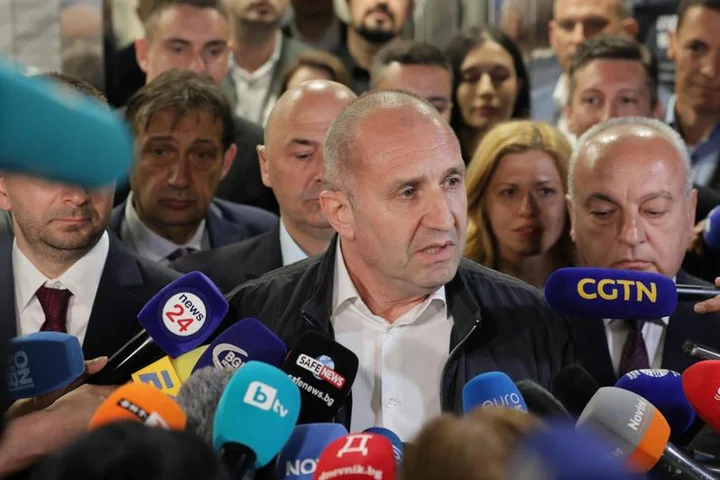
Rumen Radev's new center-left party, Progressive Bulgaria has won an absolute majority in the country's eighth general election in five years.
Both Russia and the EU have already sent their congratulations.
Progressive Bulgaria, the party led by former President Rumen Radev, won a landslide victory in general elections in Bulgaria, official results showed on Monday.
The party secured 44.6% of the votes after counting was complete.
That means Radev's party is on course to win around 130 seats in the 240-seat parliament.
It represents a better-than-expected performance and appears to be one of the largest parliamentary mandates by any party in recent years.
Progressive Bulgaria finished far ahead of the pro-European We Continue the Change-Democratic Bulgaria (PP-DB) coalition, and the long dominant center-right Citizens for European Development of Bulgaria, or GERB party, led by former Prime Minister Boyko Borissovat.
EU and Russia both welcome Ruman Radev's election win
Radev has called for a renewal of ties with Russia and is known as a critic of the EU.
His election was welcomed by Kremlin spokesman Dmitry Peskov, who said on Monday that Russia was "impressed by the statements made by Mr Radev."
European Commission chief Ursula von der Leyen also sent her congratulations.
"Bulgaria is a proud member of the European family and plays an important role in tackling our common challenges," she said in a post on X, adding that she "looks forward to working together."
What to know about Bulgaria's general election
The snap vote follows the resignation of a conservative-led government amid nationwide anti-corruption protests last December.
Bulgaria, the EU's poorest member, has been gripped by a political crisis since 2021, when the conservative government of Boyko Borissov was toppled, also amid anti-corruption rallies.
Bulgaria is also a member of NATO.
It joined the eurozone on January 1, shortly after entering the border-free Schengen travel area
The Sunday vote marked the eighth election in five years.
Many hope that the outcome will put an end to the political impasse that has long dogged the country.
"We will do everything possible not to allow us to go (to elections) again.
It is ruinous for Bulgaria," Radev said after the polls closed on Sunday.
Will Sunday's election end Bulgaria's political paralysis?
To view this video please enable JavaScript, and consider upgrading to a web browser that supports HTML5 video
A newly-formed center-left grouping under former President Rumen Radev, Progressive Bulgaria, had been tipped as the likely winner ahead of the vote, though also projected to fall short of an absolute majority.
After casting his ballot on Sunday, the 62-year-old Radev urged other people to vote, saying that mass voting was "the only way to drown vote-buying in a sea of free votes."
Radev, a former air force general who was president of Bulgaria for nine years before stepping down in January to run in the election, has pledged to combat what he calls the "oligarchic governance model" in the country.
He has also advocated for Bulgaria to renew ties with Russia, while being critical of military aid to Ukraine as it fights the ongoing invasion by Moscow's troops.
He has, nonetheless, officially denounced Russia's invasion and said he would not use his country's veto to block EU aid to Kyiv if elected.
Radev also opposes the EU's green energy policy, which he considers naive "in a world without rules."
Borissov pessimistic while casting his vote, changes tune later
While voting in Bankya, on the outskirts of Sofia, on Sunday, Borissov, the former prime minister, seemed less-than-hopeful about his party's prospects.
He stressed that GERB will not enter any coalitions.
"I don't see who we can enter a coalition with," he was quoted as saying by Bulgaria's national broadcaster.
The ex-PM said his party will instead act as constructive opposition and take part in topics related to geopolitics, such as national defense.
Later on Sunday, however, he seemed more confident despite his party's setback.
"Winning the election is one thing; governing is quite another.
The election determines who is first, but negotiations will determine who governs.
GERB can go into government and into opposition.
And in politics, just as in life, patience is needed," the GERB leader noted.
Borissov has served three terms as Bulgaria's prime minister.
During the campaign, he has highlighted his GERB party's record, saying it had "fulfilled the dreams of the 1990s," among other things by having Bulgaria join the eurozone this year.
Bulgaria's big currency gamble adopting the euro
Edited by: Sean Sinico and Wesley Dockery
Related Stories
Source: This article was originally published by Deutsche Welle (DW)
Read Full Original Article →
Comments (0)
No comments yet. Be the first to comment!
Leave a Comment