
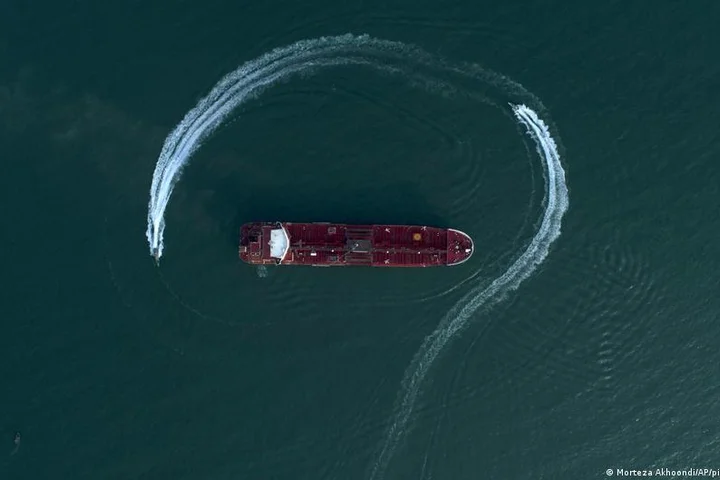
President Donald Trump wants to use the blockade to stop Iran from collecting transit fees and to cut off its oil revenue.
Oil prices rose sharply after the announcement.
Follow DW for more.
Donald Trump orders US blockade of Strait of Hormuz after talks fail
Ceasefire talks between the US and Iran ended without an agreement
Here's a round-up of all the latest developments on the US-Israel's war with Iran on April 13, 2026:
Oil tankers avoiding Strait of Hormuz ahead of announced US blockade
Despite US assurances that a planned blockade of Iranian ports on Monday will not restrict transit through the Strait of Hormuz, the waterway is being avoided by most oil tankers.
Just four tankers carrying oil, gas or chemicals have crossed the Strait of Hormuz so far on Monday ahead of the announced blockade, according to tracking data provided by MarineTraffic.
Two Pakistan-flagged tankers entered the Gulf on Sunday before the US announcement.
An average of 138 ships transited the strait each day before the conflict started on February 28, according to the multinational Joint Maritime Information Center.
Hundreds of ships are currently stuck in the region waiting for conditions that guarantee their safety, as tanker owners warn that thousands of crew members are running short on water and food.
US Central Command said US forces would start a blockade of all maritime traffic entering and exiting Iranian ports at 5:30 p.m.
Iranian local time (1400 GMT) on Monday.
The blockade will be "enforced impartially against vessels of all nations entering or departing Iranian ports and coastal areas, including all Iranian ports on the Arabian Gulf and Gulf of Oman," it said in a statement on X.
Since the war begam, Iran has effectively shut the strait to all vessels except its own, saying ships will be permitted to transit only under Iranian control and subject to a fee.
France, UK to host talks on 'peaceful multinational mission' for Strait of Hormuz — Macron
French President Emmanuel Macron has said that France and the UK will soon organize an international conference to discuss a potential naval mission that would aim to restore "freedom of navigation" in the Strait of Hormuz, which has been largely blocked by Iran amid the US-Israeli offensive against it.
Macron reiterated that the mission would be "strictly defensive," and separate from the warring parties to the conflict."
In his statement on X, Macron said once more that "[n]o effort must be spared to swiftly reach, through diplomatic means, a strong and lasting settlement to the conflict in the Middle East," adding that "France stands ready to play its full part."
The current situation in the waterway, through which some 20% of the world's oil and liqueified natural gas (LNG), along with nearly half of the world's traded urea, the most widely used nitrogen-based fertilizer, normally passes, has caused economic disruption across the globe amid rising prices for the commodities.
UK' will not be dragged into Iran war — PM Starmer
British Prime Minister Keir Starmer said on Monday that no amount of pressure would coerce Britain into actively participating in the US-Israeli war on Iran or the blockade of the Strait of Hormuz announced by US President Donald Trump.
"We're not supporting the blockade," he told broadcaster BBC Radio 5 Live, adding that it was vital to get the waterway reopened.
"It is, in my view, vital that we get the Strait open and fully open, and that's where we've put all of our efforts in the last few and we'll continue to do so," Starmer said.
Britain had minesweepers in the region, he said, but added that the deployment was "focused from our point of view on getting the Strait full open
Iran war likely to have long-term effect on German economy — Economy Minister
Germany is likely to suffer under economic fallout from the US-Israel war on Iran for the rest of 2026, according to a monthly report from the Economy Ministry.
"Further economic development depends significantly on a resolution of the conflict in the Middle East.
However, even then, high energy prices, supply problems, and economic burdens are likely to persist for some time," it said on Monday.
It said that the best that could be hoped was that energy and raw material prices would be gradually normalized again in the course of the year.
The report comes as oil prices rose again on Monday after US President Donald Trump vowed to fully block the strategic Strait of Hormuz.
German Chancellor Friedrich Merz has announced that the government will reduce energy taxes on diesel and petrol by about 17 cents per liter (19.9 US cents) for two months to cushion the impact on consumers, also saying that "the German economy will face a significant burden over an extended period."
You can read more about his comments and the steps Germany is taking to counter the negative impact of the Iran war over at our Germany news blog.
Iran says US naval blockade 'illegal'
Iran's military said the announced US naval blockade, set to begin on Monday, would be illegal and described it as piracy.
It said Gulf ports could be at risk if Iran's own ports were threatened.
"The restrictions imposed by criminal America on maritime navigation and transit in international waters are illegal and constitute an example of piracy," a statement read on state television declared.
"If the security of the Islamic Republic of Iran's ports in the waters of the Persian Gulf and the Arabian Sea is threatened, no port in the Persian Gulf and the Arabian Sea will be safe," it added.
Trump slams Pope Leo XIV over Iran war
US President Donald Trump slammed Pope Leo XIV after the Catholic leader appealed for peace amid the war in the Middle East.
The 70-year-old, the first American pontiff, publicly implored leaders on Saturday to end the violence, telling worshippers at St Peter's Basilica: "Enough of the idolatry of self and money!
Enough of the display of power!
Enough of war!"
Following the speech, Trump said he was unimpressed with the leader of the Catholic Church.
"I'm not a big fan of Pope Leo.
He's a very liberal person, and he's a man that doesn't believe in stopping crime," Trump told reporters at Joint Base Andrews in Maryland.
Trump also accused the pontiff of "toying with a country that wants a nuclear weapon."
Criticizing the pope further on his Truth Social account, Trump said, "I don't want a Pope who thinks it's OK for Iran to have a Nuclear Weapon."
"Pope Leo is WEAK on Crime, and terrible for Foreign Policy," he said.
The president added that Leo had only been elected "because he was an American, and they thought that would be the best way to deal with President Donald J.
Trump."
"If I wasn't in the White House, Leo wouldn't be in the Vatican."
Oil prices surged in early trading on Monday after President Donald Trump vowed to fully block the strategic Strait of Hormuz.
US crude jumped 8% to just over $104 a barrel, while Brent crude rose 7% to above $102.
That compared with prices of around $70 a barrel before the war began in late February.
The Strait of Hormuz is a vital shipping route for global energy supplies, carrying roughly a fifth of the world's oil.
Speaking to Fox News, Trump said oil and gasoline prices could stay high through November's US midterm elections.
US military says it will blockade Iranian ports
The US military announced that it will blockade all Iranian ports and coastal areas on Monday, tempering US President Donald Trump's earlier stance to completely block the strategic Strait of Hormuz .
US Central Command said the blockade would begin on Monday at 2 p.m.
GMT, or 5:30 p.m.
in Iran, and would be "enforced impartially against vessels of all nations entering or departing Iranian ports and coastal areas, including all Iranian ports on the Arabian Gulf and Gulf of Oman."
However, ships traveling between non-Iranian ports will be allowed to pass through the strait, scaling back the president's earlier threat to blockade the entire waterway.
Trump confirmed the US military's statement on his Truth Social platform.
Trump said on Sunday that his goal was to clear the strait of mines and reopen it to all shipping, but that Iran must not be allowed to profit from controlling the waterway.
US warships test Hormuz passage as mine risks loom
To view this video please enable JavaScript, and consider upgrading to a web browser that supports HTML5 video
Iranian leaders have vowed to counter the blockade.
Before the US military's announcement, Iran's Revolutionary Guards warned that they had full control of traffic through Hormuz and would trap any challenger "in a deadly vortex."
After an unsuccessful round of talks over the weekend between Iranian and US delegations in Pakistan, the Trump administration has threatened a naval blockade of Iranian ports.
The influential speaker of Iran's parliament, Mohammad Bagher Ghalibaf, said the US representatives had been "unable to gain the trust" of Iranian officials.
Iranian authorities blamed the US for placing "unreasonable" and "excessive" demands.
Meanwhile, Trump has intensified his attacks on Pope Leo XIV over his comments on the war with Iran.
Stay tuned as we cover the latest developments in the US-Israel war with Iran.
Related Stories


Source: This article was originally published by Deutsche Welle (DW)
Read Full Original Article →
Comments (0)
No comments yet. Be the first to comment!
Leave a Comment