
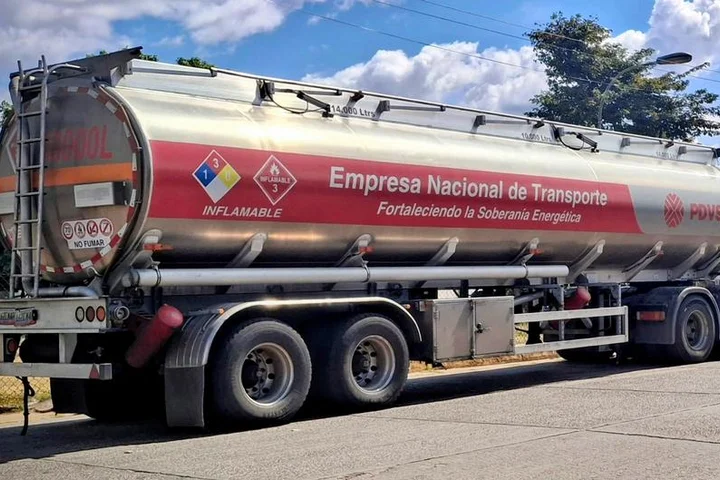
After the US ousted Maduro and effectively seized control of Venezuela's oil industry, the country's economy has been transitioning rapidly.
The interim government is wooing investors but lacks democratic backing.
In the past few days, Spanish airline Iberia has resumed landing in Caracas, and American Airlines has also announced plans to return to Venezuela .
Paraguay , meanwhile, is building support to reverse the suspension of Venezuela's membership in the South American trade bloc Mercosur .
"This is one of the initiatives we'd like to advance during Paraguay's pro-tempore presidency," Marco Riquelme, Paraguay's new minister of industry and commerce, said at a press conference in late March.
Should the initiative succeed, this would also impact the European Union , which recently closed a wide-ranging free trade agreement with Mercosur that's slated to go into effect on a provisional basis on May 1.
Not even four months after then-president Nicolas Maduro was removed from power in a controversial military operation by the US, Venezuela has seen economic conditions shift dramatically .
Venezuela is the most oil-rich country in the world based on proven oil reserves.
Reviving its oil industry is therefore key to helping the economy get back on its feet after years of crippling sanctions imposed by the US, EU and others.
Long lines in front of gas stations have now grown shorter, or disappeared altogether.
Venezuela recently reported that its monthly crude oil exports had surged past an average of 1.1 million barrels per day (bpd) in March for the first time since September.
In 2024, the country's output was a little over 893,000 bpd.
The fact that Venezuela has increased its output runs contrary to the global trend which , according to the Organization of the Petroleum Exporting Countries ( OPEC ), saw crude oil production drop by 27% in March due to the US-Israeli war with Iran .
Oil companies redoubling their efforts
This trend in Venezuela is expected to continue.
The Spanish energy group Repsol has just announced it is soon planning to resume operations in Venezuela.
Further details were not released following a meeting between Repsol executives and acting president Delcy Rodriguez .
Specifically, the two major deals Chevron signed with Venezuela's state-owned oil company PDVSA involved asset swaps that left the US company with nearly half the total stake in the joint venture Petroindependencia, as well as added rights to develop a new oil area in Venezuela's vast oil-producing region, Orinoco Belt.
Trump's Venezuela oil gambit: Constraints and global impact
To view this video please enable JavaScript, and consider upgrading to a web browser that supports HTML5 video
However, Ronald Balza, who heads the Faculty of Economics and Social Sciences at the Andres Bello Catholic University (UCAB) in Caracas cautioned that dealings in the oil industry are nearly impossible for outsiders to monitor.
He told DW that it's tricky to gauge recent developments because the US has yet to provide transparent or regular payments for the oil Venezuela is delivering.
That's why "developing forecasts in terms of prices, employment and the allocation of public funds, or any other normal government activities," is so difficult, Balza explained.
The current acting government under Rodriguez has not been legitimized in a democratic process.
In an interview with the Madrid-based media platform The Objective, Ricardo Hausmann, renowned Venezuelan economist and Harvard professor, even spoke of a dictatorship.
"If [US President Donald] Trump says he controls Venezuela, he has to guarantee the freedom, security and rights of [prominent political figure] Maria Corina Machado .
Her absence from the country reflects that the dictatorship continues," he said.
The politician and human rights campaigner Machado was awarded the 2025 Nobel Peace Prize , which she gifted to Trump as a "symbol of gratitude on behalf of the Venezuelan people.” She has been living in exile due to what she says are security concerns since the last disputed election in Venezuela.
Trump accepts Machado's Nobel medal in White House meeting
But even if she's not in the country, she's still been actively campaigning for her political vision.
"Under our government, Venezuela is going fully private,” she recently told top energy executives at the annual CERAWeek energy conference in Houston.
"For the first time in Venezuelan history, the state will get out of your way, and pave the way, by focusing on what it should do: establishing clear rules, enforcing contracts and guaranteeing long-term certainty for your investments."
For now, interim president Rodriguez holds the reins in Venezuela.
She's been courting US investors and capital , and in late March even joined an international investment forum to woo foreign financiers .
Her appearance would have been unthinkable just months ago.
But Rodriguez has been lifting state regulations to lure more private investment.
An opportunity for European businesses?
In light of the many changes in Venezuela's economy of late, local media have been speculating whether the German multinational Siemens will be involved in rebuilding Venezuela's power infrastructure.
"Economic growth depends on a stable electricity grid," Paul Marquez, head of the Zulia state chapter of the Venezuelan Federation of Chambers of Commerce and Production (Fedecamaras), Venezuela's main business union, told the financial news portal Banca y Negocios.
"Without electricity it won't be possible to increase oil production."
He also said that Siemens was working out proposals for the authorities.
When approached by DW, Siemens would neither confirm nor deny the information.
"We are in close contact with our local team and are actively assessing all potential effects on our operations.
We will closely monitor the developments and assess how they affect our business,” a Siemens speaker told DW.
"As long as instability prevails, our focus lies with ensuring the safety of our employees," she added.
For the time being, this appears to be the main theme of Venezuela's current circumstances: caught somewhere between readiness and uncertainty about the future.
This article was originally published in German.
Related Stories

Source: This article was originally published by Deutsche Welle (DW)
Read Full Original Article →
Comments (0)
No comments yet. Be the first to comment!
Leave a Comment