
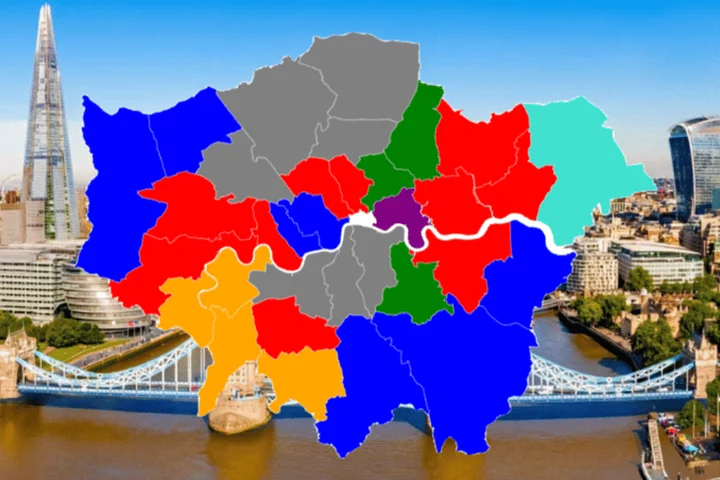
Negotiations over who will lead more than half a dozen London councils are ongoing after seven boroughs failed to elect a party with an outright majority.
Sir Keir Starmer's party lost control of half of the 21 local authorities it won in 2022.
By Saturday afternoon, the Prime Minister’s premiership was in increasing jeopardy as London MP Catherine West warned that, if a cabinet minister did not put themselves forward to challenge Sir Keir, she would attempt to trigger a leadership contest herself.
The Hornsey and Friern Barnet MP told the BBC she was putting the cabinet “on notice” and would ask colleagues to back her if she did not hear from a leadership hopeful by Monday.
For a leadership election to begin, 81 MPs (20%) would have to back a single challenger.
Mayor of London Sadiq Khan accused Labour of taking the capital “for granted for too long” and failing to deliver the change it had promised after a round of devastating defeats saw the party lose Lewisham, Hackney and Waltham Forest to the Greens, while Westminster fell to the Conservatives.
Meanwhile, Brent, Barnet, Enfield, Haringey, Southwark, Lambeth and Wandsworth fell into no overall control (NOC) after decades of Labour rule, meaning no single party can govern alone.
These seven boroughs will now have to decide on a leader, and parties may need to come together to form coalitions.
Negotiations are understood to already be underway in most boroughs.
But after a fiercely fought, and sometimes deeply personal, campaign, working together may prove difficult for some individuals.
One London Labour councillor told the Standard: “It’s not going to be pretty.
A lot of concessions, maybe some apologies on both sides, are going to need to be made.”
On the eve of the election, Labour headquarters sent out a dossier accusing Green candidates of various offences, including antisemitism, criminal damage and, in one case, drug trafficking.
Many of those Green candidates, including Lambeth’s Saiqa Ali, who was arrested the week before the vote over alleged antisemitic social media posts, and Carlotta Allum, who was caught at Los Angeles airport with 10,000 ecstasy tablets strapped to her nearly 30 years ago, are now councillors.
To form a coalition, two or more parties must agree to work together to create an administration, often sharing cabinet positions and backing joint programmes.
These arrangements can involve unusual alliances driven more by local issues than national politics.
Local elections 2026: All the London results
Cabinet must unite around a new leader to take fight to Reform, Labour MP says
Starmer faces leadership challenge as rebel London MP issues ultimatum to cabinet
Art After Dark is back with an exciting calendar of cultural events
Zack Polanski’s party is the largest in Lambeth with 29 seats to Labour’s 26, but it failed to win an outright majority.
The eight Liberal Democrats elected could now form an alliance with either party to determine the council leadership.
In Barnet, Labour and the Conservatives both won 31 seats.
This means the single new Green councillor could decide who leads the town hall, unless the Tories and Sir Keir’s party work together.
Some boroughs may opt for a minority administration, where the largest party takes control and relies on support from other councillors on a vote-by-vote basis.
These administrations can survive only if opposition groups do not unite against them.
A third possibility is a looser arrangement involving smaller parties.
Some councils have also operated through informal agreements, where councillors support an administration on budgets and major decisions without formally joining it.
The key moment will come at the full council meetings, usually held within two weeks of the election.
There, councillors will vote to appoint the leader, cabinet members and committee chairs.
Whoever can command majority support in the chamber effectively runs the authority.
Importantly, the largest party does not automatically take power.
If other groups combine to form a majority, they can shut the biggest party out of office altogether.
Related Stories


Source: This article was originally published by Evening Standard
Read Full Original Article →
Comments (0)
No comments yet. Be the first to comment!
Leave a Comment