
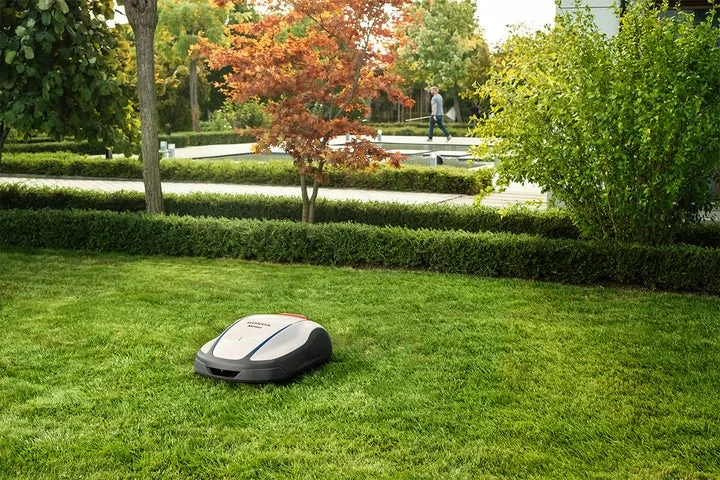
From avoiding obstacles to coping with wet weather, we sort the fact from the fiction when it comes to autonomous mowing
If you’ve spent your weekends wrestling with a petrol mower or worrying about the impact of your garden maintenance on the environment, you might have considered a robotic alternative – only to be held back by common misconceptions.
While rumours of complicated setups and fragile technology persist, the reality of modern autonomous mowing is far more efficient.
We’re debunking the biggest myths surrounding robot lawn mowers, to show you how easy it is to achieve a pristine lawn without sacrificing your free time.
Myth One: They take ages to install
Even in large gardens with complex designs, installing the wire for the Honda Miimo is a straightforward process.
All you have to do is lay the wire 20 cm within the lawn perimeter and peg it in every 1–2 metres with the simple-to-use pegs that come included with the mower.
If you have trees within the lawn or ponds, they can easily be ringed off.
Then, all you need to do is set your chosen grass height, choose a point for the docking station, charge the battery, and you’re off.
In a few weeks, your grass will have covered the wire so you can’t see it anymore, and you’ll be well into the “set and forget” territory of lawn management.
(If you do want to make any changes, you can easily update your mower’s schedule using an app on your phone).
Myth Two: They can’t deal with obstacles
Families with children who frequently find frisbees, balls, and the occasional lost shoe on the lawn need not worry.
The Honda Miimo is fitted with rapid-reaction 360-degree bump sensors and these ensure that Miimo immediately stops should it come into contact and then moves in a different direction, allowing the safe retrieval or removal.
Fallen fruit does, ideally, need to be cleared before the Miimo goes to work, but that is of course true of walk-behind mowers too – and you can always adjust your perimeter for the part of the season when it’s an issue.
Myth Three: They’re bad for nature
Far from it.
Autonomous mowers are actually good for nature, particularly in terms of lawn health.
Whereas owners of regular mowers might mow their lawn every couple of weeks, a robotic lawnmower can go out every day, cutting off only the very tops of the grass.
The tiny clippings then go back into the soil as mulch, helping to reduce moss.
And compared to petrol-powered lawnmowers, all-electric autonomous mowers reduce your carbon footprint and prevent local emissions.
Myth Four: They’re not suitable for the UK’s wet weather
On the contrary, the Honda Miimo is fully weatherproof and operates effectively in the rain.
Its choice of cut height means that you can set it as high as 60mm during periods of prolonged wet weather when you want to keep the grass longer to maintain lawn health and prevent clogging.
You can then take it down to 20mm in the summer for a beautiful lawn finish, or set it at 40mm during a heatwave to ensure that the grass is giving adequate shade to the soil.
Myth Five: They’re for lazy gardeners
The Brits are famously a nation of hardy gardeners, and while some find virtue in mowing their lawn the old-fashioned way, for many others a robotic mower is a time-saving device.
It frees them up so they can devote more energy to the parts of gardening that give them the most joy: planting and sowing, pruning bushes, and tending to borders.
Related Stories



Source: This article was originally published by The Independent
Read Full Original Article →
Comments (0)
No comments yet. Be the first to comment!
Leave a Comment