
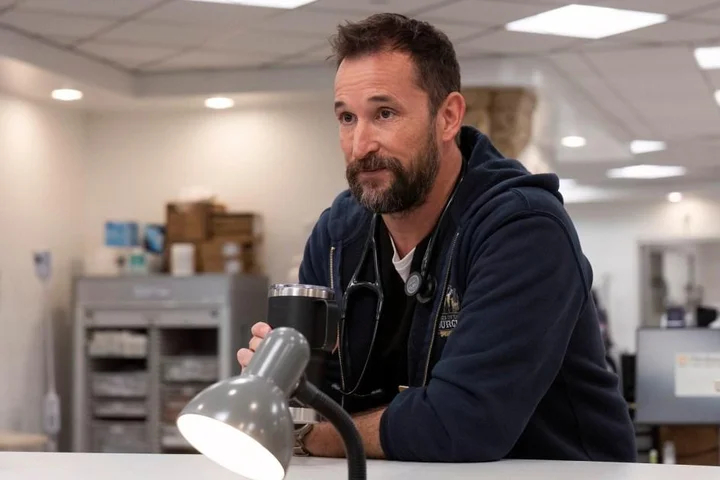
‘It’s just a TV show – it’s not that deep.’
That was the thought going round and round in my head as I looked at the latest online rant from a fan of hit real-time medical drama, The Pitt.
The post, which was accompanied by a GIF from the show of Dr Mel King having an emotional breakdown, said: ‘If the writers and producers keep messing with the fandom like this, The Pitt is heading straight for cancellation after Season 3.’
In response, one observer on X namechecked the guidebook used to diagnose mental health conditions, saying: ‘We gotta get Fandom in the DSM VI.’
It’s harsh – but I felt it had merit.
Because to suggest that The Pitt, which won practically every season one Emmy it was up for, is getting worse simply because it’s not aligning with its fans’ very specific plot and character expectations is, frankly, a little unhinged.
From conspiracies about storylines and behind-the-scenes rifts to rampant indignation when fan theories don’t come to fruition, the fandom is giving an overwhelming sense of, as one X user called it, ‘baby’s first prestige TV show’.
And this inability to handle very normal and easy-to-understand plot devices like misdirection and flawed protagonists seems to be a leading cause of the building backlash.
As a fan of the show myself, I find these so-called ‘Pitt Bullies’ embarrassing.
Fandom once referred quite specifically to the practice of intensive love, only used to refer to the true diehards, like Trekkies.
But now it has been flattened to mean anyone who happens to simply enjoy a show, and so discussion about any particular set of ‘fans’ immediately gets more complicated.
These fans see themselves as the proper ambassadors of the show, who hold its fate in their hands.
And this is why fandom is in such a weird place: because of this sense of ownership, anything that chafes against their version of it is treated as a violation.
The Pitt prides itself on its portrayal of the struggles of healthcare workers, and will never shy away from a teachable moment – whether it’s about the outrageous cost of healthcare, the system’s overstretched resources, or ICE agents invading the ER (a friend of mine referred to these scenes as ‘Sesame Street for adults’).
Admittedly the treatment of these themes is sometimes a bit heavyhanded, but you cannot fault the intention.
Except no: apparently you definitely can.
The fandom frequently does battle with itself over these teachable moments, occasionally because something is ‘too woke’, but more often because it’s ‘not woke enough’.
In the case of the ICE raid, critics argued that the portrayal was too balanced.
This is despite producer John Wells being quoted as saying ‘We’re not really in the business of preaching to the choir on this show.’
In part, it’s this preference for storytelling that focuses on what is ‘factually happening’, as Wells describes it, and to present uncomfortable truths in a way that isn’t particularly politicised, that has incensed so many fans.
They don’t want a realistic portrayal of an imperfect world, they want a realistic portrayal of a perfect one – and that simply doesn’t exist.
Because of its sense of balance, The Pitt also doesn’t really have a proper villain.
The fact that all its characters possess both good traits and bad are part of what make it so realistic and so compelling.
For example, Dr Langdon stole painkillers from the ER while he was in active addiction, and he’s also a kind and compassionate mentor to Dr King.
The show asks us to hold both those things in our heads at the same time.
But for some fans, in the absence of a true villain, it seems like Dr Robby’s all-consuming personality, alongside star, writer and producer Noah Wyle’s control over the series itself, is it.
This became very clear when it was announced in early April that Supriya Ganesh, who plays Dr Samira Mohan, would be leaving the show at the end of the second season, for storyline reasons.
The response from some fans was sheer outrage – ‘Such a weak excuse ..
no one’s buying that’, one X user said – and most of it has come to be directed at one person: Wyle.
Fans say he ‘has the serial killer gene’, and compare him to Benjamin Netanyahu.
Wyle has been identified as the reason the show is doing all the wrong things, with a common sentiment being that the second season is not what they signed up for, due to its changed cast and focus on Dr Robby’s mental health and unpredictable, at times irrational, behaviour.
This conflation of Wyle and Robby is interesting, particularly since a key theme of the series is how detrimental it can be for every single doctor and nurse in the ER to be held to Robby’s impossible standards.
In other words, many fans are attacking precisely what the show itself is attempting to say about its lead character and his insistence, conscious or not, that everyone define their value in relation to him.
It’s worth mentioning that Wyle did himself no favours when he said recently, ‘I made jokes this season where I’d get done yelling at somebody and say, ‘Someone bring me another woman to yell at.’
The over-the-top online response that he quit acting to become a manosphere influencer was something of an overreaction, but I cannot deny that even in jest, this was probably an inadvisable thing for him to say.
There are also countless examples of fandoms gone astray, or attempts to psychoanalyse their preoccupations (think of Heated Rivalry earlier this year), or clusters of fan behavior that go beyond typical fan-fiction and edits and into the realm of bullying and obsession.
I can’t help but think we seem to be veering into that territory here.
The Pitt fans have been accused of being bad at watching TV.
I don’t think that that’s necessarily the case.
The issue is that they seem to consider their fandom a moral responsibility, and that when the show doesn’t align with their expectations, it’s immediately – and objectively – a failure.
Showrunners shouldn’t have to prioritise fan satisfaction above all else.
Not only is it impossible, but it’s also not how entertainment works, and to pretend it does is doing a disservice to all involved.
People need to understand that watching something that makes them uncomfortable is no reason to spiral into paranoid overanalysis or personal attacks.
So if you find yourself displaying symptoms of belonging to an unhinged fandom, you might want to take a step back from the keyboard.
Like I said – I mean this as politely as possible – it’s just a TV show.
Related Stories


Source: This article was originally published by Metro UK
Read Full Original Article →
Comments (0)
No comments yet. Be the first to comment!
Leave a Comment